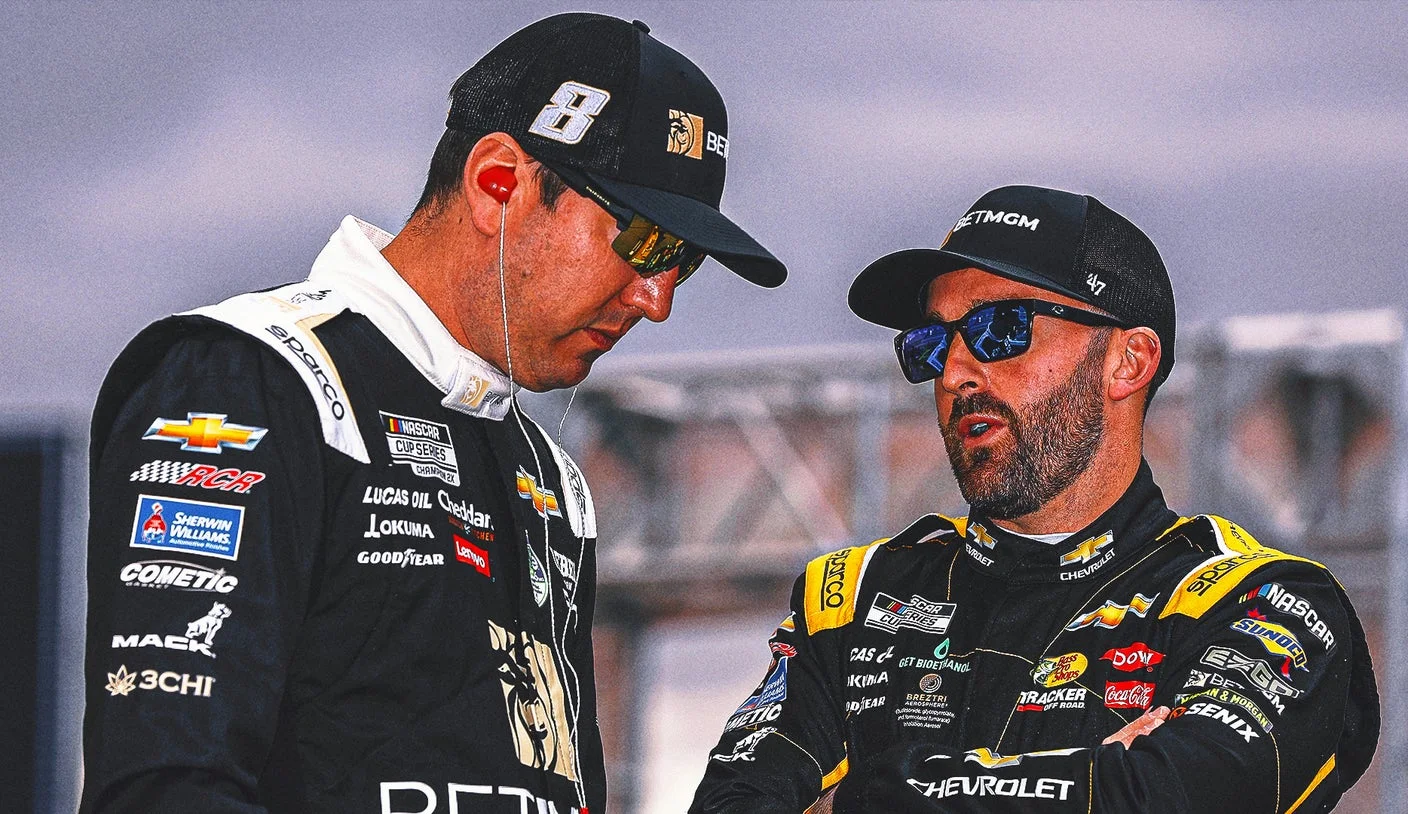
Richard Childress Racing has come under intense criticism following Kyle Busch‘s disappointing performance at Talladega, a development that has sparked debate throughout the NASCAR community. On a race weekend where expectations were high, Busch finished in an uncharacteristic 27th place, casting a dark cloud over the season’s aspirations for both the driver and his team. Kevin Harvick, renowned for his candid takes, pulled few punches and placed responsibility squarely on the shoulders of Richard Childress Racing, in a move that has further fueled controversy and discord.
The disappointment at Talladega was unmistakable, especially as Busch’s No. 8 car initially showed promise in the opening laps, running comfortably in the top 10. However, a combination of errors—most notably, a costly speeding penalty and a pit-stop blunder—derailed any chance the team had for a strong finish. The car’s 11th-fastest rank in green-flag speed could not make up for the mistakes that ultimately buried their race hopes. Busch shouldered some of the blame, stating, “Excuses are excused, I sped, and yeah, threw our race away,” but it quickly became apparent that the problems ran deeper than just a driver’s miscalculation.
The broader context paints a conflicted picture for Richard Childress Racing. Despite moments of competitiveness, the No. 8 team has languished in 17th place in the overall standings, a situation that led Kevin Harvick to a blunt assessment during the Happy Hour podcast with Kaitlyn Vincie and Mamba Smith. “When you look at Kyle Busch and that whole team, they’re 17th in the points right now, but I feel like they’ve had their moments where they’ve run a lot better than that,” Harvick noted, highlighting a recurring pattern of mistakes. “And you know, Kyle, in general, we’ve seen him spin out in qualifying. We’ve seen mistakes on pit road. He’s had four speeding penalties on pit road. They’ve had one loose wheel. Their pit crew is the 20th-ranked in just overall speed.”
That critique exposes a significant fault line within Richard Childress Racing. It is not just about whether the organization provides Busch with a competitive car or fast qualifying times. The repeated breakdowns on pit road—ranging from slow stops to technical errors—have become a symbol of the team’s operational shortcomings. Harvick referenced how, in contrast, Denny Hamlin’s team capitalized on pit precision to grab victories, further stressing the importance of flawless execution under pressure. Harvick’s assertion finds resonance with many observers who feel that Richard Childress Racing, in its current state, is not equipping its star driver with the tools needed to deliver results.
Busch’s frustration is not new, nor is it isolated. Historically, he has been vocal about the need for operational excellence, especially regarding pit stops. A year ago, issues at Phoenix prompted the team to swap pit crew members for the third time, a disruptive move that arguably compromised the consistency Busch has long advocated for. The driver’s candid assessment underscored the stakes: “The easiest place to pass somebody else is when they’re sitting still, on pit road. So we have to be better on the pit road.”
Within Richard Childress Racing, this tension has not gone unnoticed. Andy Petree, the team’s executive vice president, acknowledged the challenges his squad faces. “We just need a consistent crew that is not going to be making mistakes. One of the problems with these young guys and development guys is you put them on Kyle’s car and he’s running second, they’re trying to win. I’m not sure they’re mentally ready for it.” Petree’s words echo a sense of unease inside the team corridors, with questions emerging over whether the crew’s inexperience is hampering their star driver’s pursuit of glory.
Busch’s own perspective broadens the debate, extending criticism toward NASCAR’s approach to driver feedback—particularly regarding the NextGen cars. Ahead of Talladega, Busch expressed his growing exasperation: “It’s really hard to get runs or create any sort of separation, especially with the fuel savings and all that sort of stuff. A shorter time on pit road is how you pass guys, and that’s no fun. So there’s definitely an issue there. I’ve made my suggestions, and (it just goes) in one ear, out the other.” His remarks highlight a tense environment, where communication breakdowns between drivers, teams, and the sanctioning body threaten to undermine the competitive fabric of the sport.
For many fans and analysts, Richard Childress Racing’s struggle with Kyle Busch stands in stark contrast to his previous success. During his tenure at Joe Gibbs Racing, Busch claimed two Cup Series championships and multiple victories—accomplishments that now seem elusive at Richard Childress Racing. Since joining RCR, Busch has secured only three wins, prompting reflection on whether the team’s systems and support structures are robust enough to sustain his championship pedigree. The mood around the No. 8 garage has grown tense, with visible frustration on both sides of the pit wall.
Harvick’s commentary has forced Richard Childress Racing into the harsh glare of the spotlight, challenging the team to confront its own shortcomings. While some observers point to isolated mistakes by Busch, the recurring narrative is that systemic problems on pit road and within team operations are to blame for the No. 8’s inconsistent results. The argument pivots on whether team leadership, training regimens, or personnel decisions are adequate for sustaining elite performance levels in today’s fiercely competitive NASCAR landscape.
It is not just team insiders who are paying attention. The entire NASCAR garage is watching closely, dissecting every move by Richard Childress Racing and their embattled driver. The scrutiny extends beyond individual races, touching on broader questions about leadership, accountability, and the kinds of decisions required to restore a once-proud operation to its former glory. Stakeholders throughout the sport are left to ask whether Richard Childress Racing can adapt quickly enough to stem the tide of criticism and reverse the current slide.
As the pressure mounts, Richard Childress faces a crossroads. The demands of NASCAR have never been higher, and the margins for error have shrunk to almost nothing. Harvick’s pointed analysis makes clear that excuses will satisfy neither fans nor sponsors if performance does not improve immediately. The noise around Kyle Busch’s results will persist until Richard Childress Racing implements tangible changes that yield measurable improvements—not just in flashes of speed, but in the kinds of reliable, mistake-free execution that wins championships.
Looking ahead, the significance of these struggles for Richard Childress Racing cannot be overstated. The team must find answers to persistent operational issues that have marred Busch’s tenure and undermined morale. Additional changes to crew composition, new training initiatives, or even leadership shifts may be on the horizon if current problems are not rectified. The stakes are raised not only by the weight of public expectation, but by the storied legacy of Richard Childress himself—a legacy now caught in the crosshairs of modern racing’s relentless pressures.
The coming races will reveal whether Richard Childress Racing can rise to the challenge or if turmoil will deepen, threatening both Busch’s and the organization’s reputations. For now, Kevin Harvick’s words hang heavy in the air, a reminder that in NASCAR’s highest ranks, accountability falls on more than just the driver—it extends across every gear, tire, and second spent on pit road. The tension within Richard Childress Racing has become a central narrative, casting a powerful light on the importance of teamwork, precision, and the relentless pursuit of improvement.