
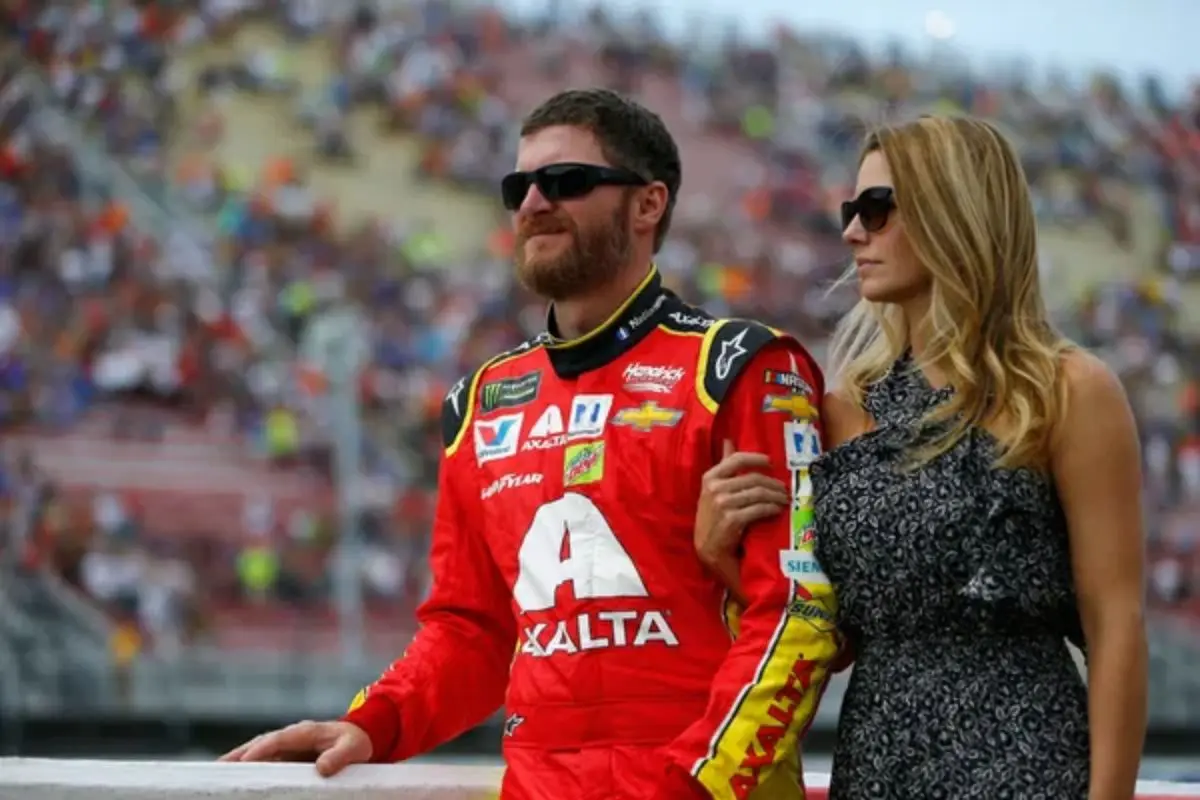
Amy Earnhardt opens up about brutal media attacks, revealing how the media misunderstood the reasons behind Dale Jr.’s exit from racing. While many blamed personal life changes, Amy Earnhardt explains the real story behind Dale Jr.‘s choice. She discusses the tough times they faced, dealing with speculation while focusing on their growing family.
Key Highlights
- Amy Earnhardt faced media criticism linking her to Dale Jr.’s retirement due to her pregnancy.
- Speculative narratives oversimplified the retirement decision, making Amy an easy target for unfounded assumptions.
- Amy maintained composure and resilience in response to public scrutiny and media attacks.
- The media incorrectly attributed Dale Jr.’s retirement to personal factors rather than his health concerns.
- Amy expressed awareness of the inaccurate and speculative stories circulating about her influence on Dale Jr.’s decision.
Amy Earnhardt Addresses Media Criticism During Dale Jr.’s Retirement
In the wake of Dale Earnhardt Jr.’s decision to retire from the Cup Series, Amy Earnhardt found herself at the center of media scrutiny, facing criticism from reporters unaware of the full context surrounding her husband’s choice.
Despite the barrage of unfounded assumptions, Amy approached the situation with remarkable composure and resilience. In an interview with Graham Bensinger, she straightforwardly discussed how she maneuvered through the media’s speculative narratives, which many believed were influenced by her pregnancy with Isla Rose Earnhardt.
Amy articulated that in the absence of extensive information, people often resorted to conjecture, making her an easy scapegoat. “I’m an easy target for something like that,” she remarked, reflecting her awareness of the media’s tendency to oversimplify complex situations.
“A lot of that was not surprising. I’m an easy target for something like that. Without a lot of information, they’re just gonna assume. It was ironic timing considering he was going to come to the end of his career anyway, and we were getting married, I got pregnant, just kind of all cumulative.”
“It didn’t bother me, I felt like I’ve developed a thick skin but it’s just easy to see that that was an easy target so it didn’t bother me and plus I stayed off social media when we were really going through the really bad parts of it.” – Amy Earnhardt
Her thick skin, honed over years of managing the public eye, allowed her to maintain perspective, recognizing the irony in the timing of events. Dale Jr.’s career was naturally winding down, and their personal milestones, such as marriage and pregnancy, coincided with his retirement announcement.

Dale Jr. Retires Due to Concussions, Not Personal Life
Dale Earnhardt Jr.’s decision to retire from professional racing was fundamentally driven by health concerns, specifically the series of concussions he sustained throughout his illustrious two-decade career.
These recurrent head injuries, accumulated over years of high-speed competition, greatly impacted his cognitive and physical abilities. Despite persistent public speculation suggesting that his decision was influenced by personal factors, such as his family life and Amy’s pregnancy, the reality was that his health was the paramount concern.
The decision to retire was neither easy nor impulsive. Dale Jr. faced the challenge of balancing his passion for racing with the undeniable toll it had taken on his health.

The cumulative effects of his concussions became increasingly impossible to ignore, manifesting in symptoms that weakened his ability to compete at the highest level.
Key factors influencing Dale Jr.’s retirement include:
- Concussion history: Multiple concussions over his career led to enduring health issues.
- Symptom management: Efforts to mask symptoms proved unsustainable.
- Health over career: Prioritizing long-term health ultimately guided his decision.
- Public speculation: Outsiders often misattributed his retirement to personal life changes.
- Family considerations: While family was a factor, it was not the primary reason.
The narrative that Dale Jr. retired due to personal life changes is a misrepresentation of his circumstances. His decision was a reflection of the complex interplay between passion and pragmatism, putting his well-being above the sport that defined him.
Dale Jr. Recalls the 1998 Daytona Crash That Damaged His Vestibular System
Amidst the public discourse surrounding Dale Earnhardt Jr.’s retirement, a significant incident from his racing career offers deeper insight into his decision to step away from the sport.
In a revealing piece for the New York Times, Dale Jr. revisited the 1998 Daytona 300 crash, a crucial moment that profoundly affected his health and racing career. The crash, which left him with a compromised vestibular system, was more than just a physical setback; it marked the beginning of a long expedition grappling with the impacts of head trauma.
The vestibular system, a critical component of the inner ear, is vital for maintaining balance and spatial orientation. Dale Jr. recounted the disorienting aftermath of the crash, noting a particularly alarming sensation a week later when he felt his car rolling despite it being stationary. This was a clear indication that the crash had inflicted damage on his vestibular system, resulting in a disconnection between his perception and reality.
The severity of the impact was demonstrated by the dent his helmet left in the steel roll cage, highlighting the force his body endured. The incident not only emphasized the inherent risks of the sport but also contributed to his eventual decision to retire, prioritizing his long-term health over continued competition.
While the media focused on numerous narratives surrounding his retirement, Dale Jr.’s retrospective on the 1998 crash sheds light on the hidden struggles that shaped his path.

The Struggles Between 2012 and 2016: Feeling Disoriented After Races
Why did the years between 2012 and 2016 prove particularly challenging for Dale Earnhardt Jr.? During this period, Earnhardt Jr. grappled with considerable health issues that persisted beyond the racetrack. Despite his resolve to compete, the aftermath of intense race weekends often left him feeling disoriented—a symptom exacerbated by the concussions he had endured.
These troubling experiences highlighted the severity of his condition and emphasized the need for a critical decision about his racing future.
- Concussion Symptoms: Recurrent symptoms that included disorientation, dizziness, and headaches.
- Medical Advice: Strong recommendations from healthcare professionals to reflect on retirement to safeguard his health.
- Mental Strain: The psychological impact of balancing professional aspirations with personal well-being.
- Public scrutiny: Scrutiny from the media and the public, questioning his ability to continue racing.
- Career Legacy: The weight of pondering how ongoing health issues could affect his legacy in the sport.
Despite the clarity of medical advice, Earnhardt Jr.’s passion for racing initially drove him to continue. However, as the symptoms became increasingly apparent and debilitating, the decision to retire became unavoidable.

News in Brief: Amy Earnhardt Opens Up About Brutal Media Attacks
The media scrutiny faced during Dale Earnhardt Jr.’s retirement decision emphasizes the complex interplay between public perception and personal health. Focusing on concussion-related issues rather than personal life highlights the importance of prioritizing athlete well-being.
The 1998 Daytona crash and subsequent struggles between 2012 and 2016 exemplify the long-term impact of injuries on professional athletes. Addressing such challenges with empathy and understanding can foster a more informed discourse around sports-related health decisions and retirements.
ALSO READ: Amy Earnhardt Misses Dale Jr.’s No. 8 Race, Reveals an Unexpected Reason

