
Key Highlights
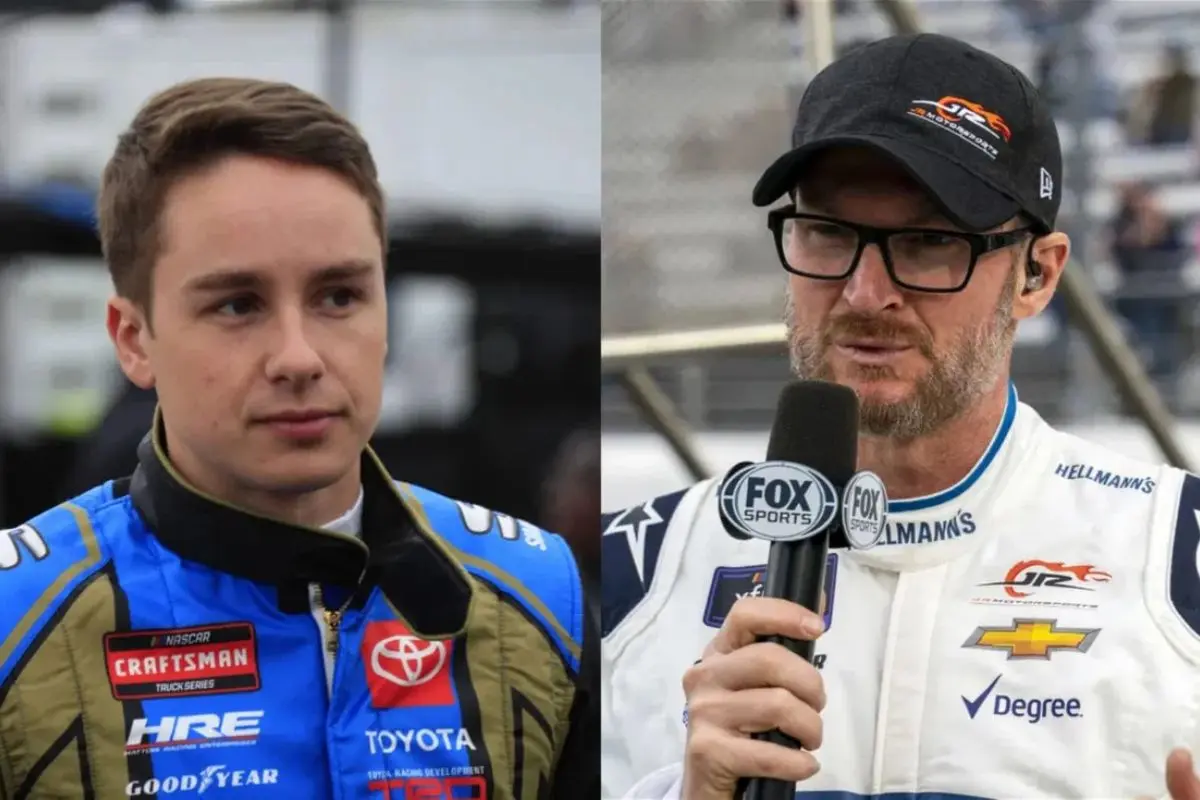
- Adam Stevens, Christopher Bell’s crew chief, criticized Daytona drivers, labeling them as “buffoons” due to inefficient racing strategies.
- Stevens highlighted the misalignment of run lengths with fuel windows at Daytona as a major issue.
- Dale Earnhardt Jr. agreed with Stevens’ critique, indicating widespread dissatisfaction with Daytona’s current racing format.
- Stevens suggested aligning race segments with fuel capacity at Daytona to encourage more competitive racing.
- The critique emphasizes the need for change to enhance Daytona’s racing excitement and competitiveness.
Christopher Bell’s Victory and NASCAR’s Controversial Call
In the wake of Christopher Bell’s victory at Atlanta Motor Speedway, the discourse surrounding NASCAR’s decision to call the race under caution has stirred considerable debate.
Bell’s performance was nothing short of commanding, as he led all but one lap, showcasing both skill and strategy.
However, the controversy lies in the governing body’s choice to finalize the race under caution, a decision met with mixed reactions from fans and experts alike.
While the No. 20 JGR team celebrates their well-earned triumph, questions about the fairness and consistency of such rulings linger.
Unlike the unpredictable nature of Daytona, where fortune often plays a notable role, Atlanta’s track configuration allowed for a more driver-centric experience.

Atlanta’s Reputation for Thrilling Finishes
Following the heated debates over NASCAR’s decisions at Atlanta Motor Speedway, attention shifts to the track’s longstanding reputation for delivering exhilarating finishes.
The venue, known for its high-speed drama, has repeatedly witnessed nail-biting outcomes, as evidenced by last year’s exciting three-wide finish. Daniel Suárez clinched victory over Ryan Blaney by a razor-thin margin of 0.003 seconds, underscoring the track’s ability to produce edge-of-the-seat moments.
Adam Stevens, Christopher Bell’s crew chief, expressed admiration for the track’s evolving dynamics, suggesting it could serve as a blueprint for improving superspeedway events at Daytona and Talladega.
His remarks highlight the potential for Atlanta’s model to inform future race formats, ensuring consistently compelling spectacles.
Consequently, Atlanta’s reputation remains firmly cemented as a bastion of exciting NASCAR finales, enchanting audiences and drivers alike.
Adam Stevens and Dale Jr. Critique Daytona’s Racing Format
Adam Stevens, known for his tactical insight as Christopher Bell’s crew chief, has stirred the NASCAR community with his pointed critique of Daytona’s current racing format.
Describing the scene as “a bunch of buffoons,” Stevens pinpointed a fundamental flaw: the misalignment of run lengths with the fuel window. This structural inefficiency pushes teams toward fuel conservation rather than competitive racing. Consequently, drivers are seen holding back, unwilling to push their vehicles to their full potential, an approach that contradicts the spirit of NASCAR racing.
“Everybody’s running around like bunch of buffoons.”
“You saw that in stage one today where you didn’t see a bunch of people limping around scared to make a green flag stop. You saw a bunch of people running hard.” – Adam Stevens
Dale Earnhardt Jr., a respected voice in the sport, echoed Stevens’ sentiments, underscoring a growing consensus on the issue. Earnhardt Jr.’s agreement lends weight to the argument, highlighting the dissatisfaction among influential figures.
“I agree to all of this. Thanks, Adam for articulating it that clearly.” – Dale Earnhardt Jr.
The critique focuses on the spectacle of top-tier drivers running at reduced power, a practice that detracts from the excitement and competitiveness expected at such a prestigious event.
 Daytona 500 Keepsake” width=”1200″ height=”800″ srcset=”https://slicksandsticks.com/wp-content/uploads/2025/02/Dale-Earnhardt-Jr.-Secures-Emotional-Daytona-500-Keepsake.webp 1200w, https://slicksandsticks.com/wp-content/uploads/2025/02/Dale-Earnhardt-Jr.-Secures-Emotional-Daytona-500-Keepsake-300×200.webp 300w, https://slicksandsticks.com/wp-content/uploads/2025/02/Dale-Earnhardt-Jr.-Secures-Emotional-Daytona-500-Keepsake-1024×683.webp 1024w, https://slicksandsticks.com/wp-content/uploads/2025/02/Dale-Earnhardt-Jr.-Secures-Emotional-Daytona-500-Keepsake-768×512.webp 768w, https://slicksandsticks.com/wp-content/uploads/2025/02/Dale-Earnhardt-Jr.-Secures-Emotional-Daytona-500-Keepsake-630×420.webp 630w, https://slicksandsticks.com/wp-content/uploads/2025/02/Dale-Earnhardt-Jr.-Secures-Emotional-Daytona-500-Keepsake-150×100.webp 150w, https://slicksandsticks.com/wp-content/uploads/2025/02/Dale-Earnhardt-Jr.-Secures-Emotional-Daytona-500-Keepsake-696×464.webp 696w, https://slicksandsticks.com/wp-content/uploads/2025/02/Dale-Earnhardt-Jr.-Secures-Emotional-Daytona-500-Keepsake-1068×712.webp 1068w” sizes=”auto, (max-width: 1200px) 100vw, 1200px” />
The Difference Between Daytona and Atlanta Racing
Despite the shared thrill of high-speed competition, the distinct racing experiences at Daytona and Atlanta reveal notable differences in their respective formats.
Daytona, known for its expansive track, often sees drivers adopting fuel-saving tactics, leading to a more conservative approach. This tendency results in prolonged drafting at reduced throttle, ultimately culminating in chaotic pile-ups known as the “Big One.”
Atlanta, redesigned to nearly a mile smaller than Daytona, encourages more aggressive racing, diminishing the emphasis on fuel conservation and enhancing genuine competition.
- Track Size: Daytona’s track is larger, promoting drafting, whereas Atlanta’s smaller track encourages aggressive driving.
- Racing Approach: Daytona often involves fuel-saving, while Atlanta supports hard racing from start to finish.
- Driver Behavior: At Daytona, cautious tactics prevail; in Atlanta, drivers push boundaries.
- Spectator Experience: Atlanta provides a more engaging spectacle, whereas Daytona’s tactical play can feel static.
Adam Stevens’ Solution to Daytona’s Racing Woes
In view of the distinct differences between Daytona and Atlanta racing, Adam Stevens proposes a straightforward yet potentially revolutionary solution to Daytona’s challenges. His approach is strikingly simple: align race segments with fuel cell capacity, eliminating the need for conservation.
Christopher Bell crew chief Adam Stevens gives his perspective on why the racing was so good at Atlanta while Daytona seemed so frustrating. Like his driver, he's not a big fan of the current state of Daytona racing. @NASCARONFOX pic.twitter.com/MBnAOWJvB9
— Bob Pockrass (@bobpockrass) February 24, 2025
This change would transform lengthy fuel stops into opportunities for relentless competition, encouraging drivers to push their limits and engage in tactical pit stops, rather than merely drafting.
Stevens draws inspiration from Atlanta’s reconfiguration, which has succeeded in creating a genuine racing spectacle by crafting a hybrid superspeedway. Unlike Daytona, Atlanta does not favor manufacturers nor does it necessitate constant braking, thereby promoting individual decision-making and skill.
“The simplest thing we could do to change it is change the run length to match the fuel cell.”
As NASCAR evaluates future seasons, the potential for Daytona to undergo notable format changes becomes more pertinent. Stevens joins a chorus of critics advocating for reforms, suggesting that even the most revered tracks might need alterations to meet the evolving expectations of competitors and enthusiasts.

News in Brief: Christopher Bell Crew Chief Criticizes Daytona Drivers
The debate surrounding Daytona’s racing format highlights the contrasting dynamics between different NASCAR tracks, with Atlanta praised for its exhilarating finishes. Both Adam Stevens and Dale Earnhardt Jr. express concern over Daytona’s current state, suggesting that changes are necessary to improve safety and competitiveness.
Stevens proposes solutions to address these issues, emphasizing the need for tactical reform. As NASCAR evolves, balancing excitement with driver safety remains vital, ensuring the sport continues to captivate audiences while prioritizing participant well-being.

