
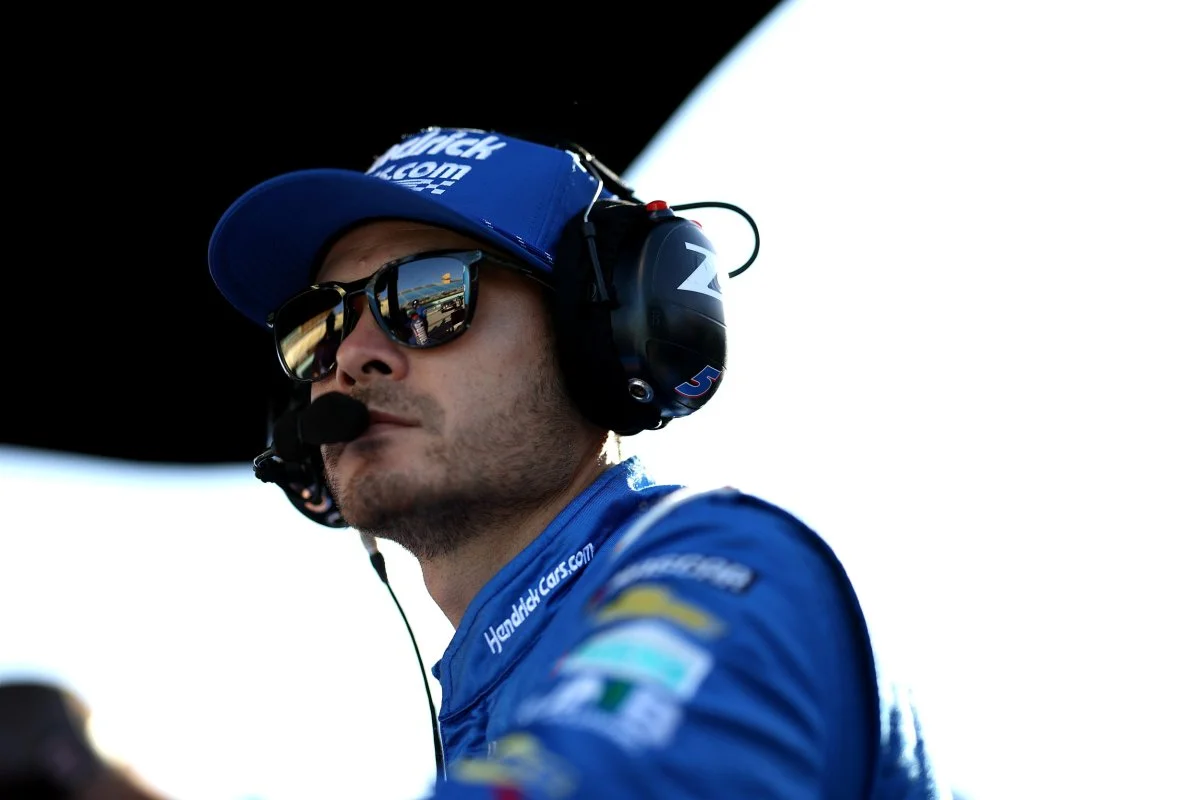
Kyle Larson, often seen as one of NASCAR’s most naturally gifted talents, has encountered a significant hurdle on superspeedways. Although he is the 2021 Cup Series champion, a win on these tracks has eluded him. As he approached the Jack Link’s 500 at Talladega, there was talk of him as an underdog—a label he openly embraced, stating, “I probably have the worst average finish here of guys with more than three years of Cup experience. So I’ll take being the underdog.” Despite securing a commendable P3 finish, his best at a superspeedway to date, Larson expressed frustration with the much-discussed Next Gen car.
The Next Gen car, introduced in 2022, promised a new era of racing equality but brought a fresh set of challenges. Many, including Larson and his on-track rival Denny Hamlin, have had to contend not only with fellow competitors but also with the car itself. Hamlin has openly criticized the rushed development and inadequate testing of the vehicle. “We didn’t have multiple racecars on the racetrack testing this car until two months before the very first race. And at that moment is when we all realized holy s—, you cannot pass. It was really, really bad,” Hamlin commented, reflecting a widespread sentiment in NASCAR garages. Echoing Hamlin’s views, Larson shared grievances about the car after his Talladega race.
When introduced to the racing scene, the Next Gen car was seen as revolutionary, aimed at fostering fairness. However, it demanded a significant adjustment from all Cup Series drivers, including Larson, essentially transforming the racing experience. The symmetrical body design and underbody aero of the Next Gen chassis, while reducing dirty air, have also impeded cars on the outside from making passing moves. With 670-horsepower engines, these cars move in closely-packed formations, limiting the opportunity for drivers to build momentum without encountering chaos.
Post-race, Larson highlighted the difficulty of overtaking, stating, “Yeah, yeah, very, very, very difficult to pass. I mean, I started the race in the back and couldn’t go anywhere. Some things got jumbled up… You need moments like that for the field to get kind of choked up and fanned out.” The move towards parity originally sparked by Jimmie Johnson’s domination in the 2000s has created such a level playing field that, without incidents, passing becomes nearly impossible. Remarkably, Sunday’s Talladega race was marked by a continuous green flag run from stage two to the finish.
These concerns were also voiced by Larson’s crew chief, Cliff Daniels, who remarked, “Typically, the stage one and stage two, you know, completion isn’t very, you know, exciting or, you know, it’s not a lot of trouble that happens along the way. So those play out more straightforward, and today I think the difference with stage three played out really straightforward.” Larson himself was surprised by his stage one success, saying, “I was a bit surprised at the end of the first stage we were able to get the top lane and get clear… It’s just confusing sometimes when runs happen… At the end, it’s really just two guys in the front row who have a shot to win it.” The car’s aerodynamics prevented Larson from capitalizing on his position behind Austin Cindric in the final stage, an issue that compounded his frustration after his finest superspeedway performance.
There’s an ongoing debate among drivers and fans alike about whether the Next Gen cars have affected the excitement typically associated with superspeedway racing. The main concern extends beyond competition to safety as well. When the Next Gen era began, drivers like Hamlin noted the increased intensity of crashes due to the car’s robust build. “I feel like my jaw was like one of those boxers that gets his whole face demolished,” Hamlin recollected after a 13-car wreck in Daytona. Although NASCAR conducted thorough investigations and made mid-season adjustments, skepticism remains. The reduced horsepower limits the driver’s ability to control dangerous situations, escalating the risk of accidents. Many drivers advocate for boosting horsepower to 750, a move that can enhance throttle response and safety.
NASCAR officials appear more concerned with maintaining thrilling, tightly packed races rather than addressing these issues head-on. While a pack of 30 cars speeding at 190 mph may look exhilarating on television, it places drivers like Larson in precarious situations, balancing the line between entertainment and potential disaster.
Amid the mounting appeals from drivers, NASCAR’s promised resolutions seem incomplete, much to the disappointment of well-known critics like Hamlin, who said, “These cars are horrendous. They’re the worst car by far in traffic than what we’ve ever had.” The reluctance of NASCAR to make substantial changes baffles many, leaving questions about whether the Next Gen car has indeed dampened the essence of superspeedway racing. Readers are encouraged to share their thoughts on whether these cars have altered the excitement of the sport.

