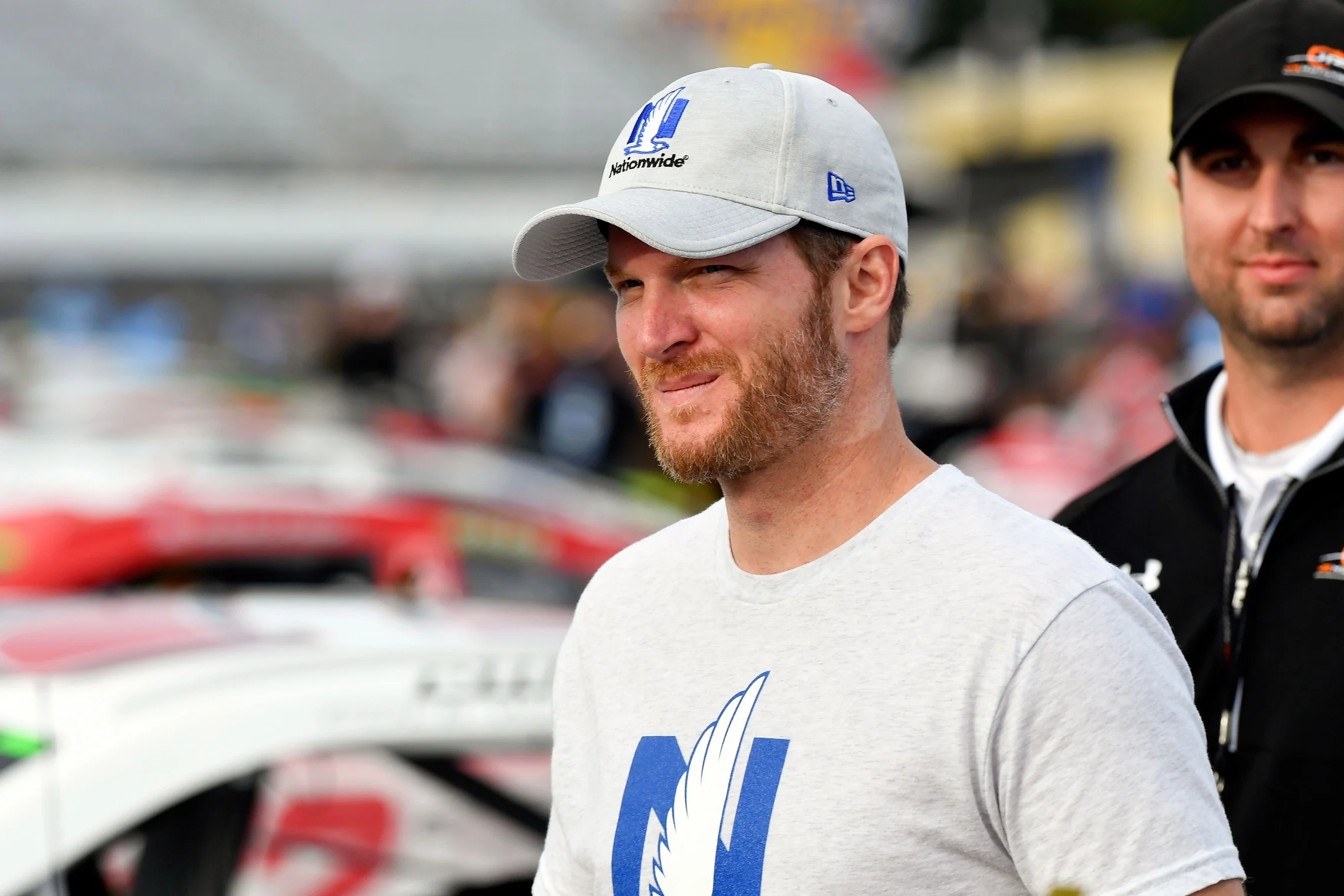
In a dramatic clash of opinions unfolding this week, Dale Earnhardt Jr disputes Denny Hamlin NASCAR cost claims involving the proposed “Run What You Brung” rules package for the upcoming All-Star Race at North Wilkesboro Speedway. Earnhardt, speaking candidly on his “Dale Jr. Download” podcast, pushed back against Hamlin’s assertion that teams would face up to $2 million in extra costs for participating, calling the estimate “overstated” and offering a more tempered view on the potential financial impact to teams preparing for the high-profile NASCAR event.
This controversy erupted just weeks ahead of the All-Star Race, as NASCAR introduced the experimental rule package in an effort to revitalize short-track racing, which has struggled to capture fans’ attention in recent seasons. Denny Hamlin, a leading driver and team owner, voiced his concerns on the “Actions Detrimental” podcast, emphasizing what he described as a prohibitive $2 million expense for teams to build and run new, specialized cars for a one-off race, even as NASCAR sought to inject fresh excitement into the competition.
Dale Earnhardt Jr disputes Denny Hamlin NASCAR cost claims directly, explaining that while there would undeniably be additional investment, the numbers being circulated were unrealistic. “That’s overstating it,” Earnhardt said, dismissively, during his own podcast. “I think it would cost the teams some money, for sure, but not $2 million. I just don’t believe it. I think that is just an excuse to say, ‘Yeah, this is why we didn’t want to do it.’ And I think he’s inflating the cost to make a point.” Earnhardt argued Hamlin’s frustration partly stemmed from the long-standing prize money, noting, “Will it cost money? He’s already mad about the damn purse being $1 million for 30 years. He said that over and over. That’s fine, that’s a great argument. I think that race should pay $3 million to the winner. The purse is absolutely a reasonable argument; he’s got a valid point.”
The source of this dispute traces back to NASCAR’s intent with the “Run What You Brung” concept, aiming to open up car modifications to encourage experimentation—specifically on short tracks that have delivered lackluster performances in the Next Gen era, such as Martinsville and Bristol. However, the proposal was met with resistance, mainly due to logistic and financial apprehensions among the teams. Hamlin made his case clear, explaining that the reduced number of allotted cars per team has heightened the stakes. “We’ve been very transparent in the fact that this car cost $300,000,” Hamlin said. “Do the math real quick. If I put my three cars on the racetrack and just to build this wild, illegal car, I’m going to destroy it and now I lose one more car out of my fleet. I only get seven cars per door number.” He continued, “You have to show NASCAR that it’s wrecked, bent or whatever and you need another chassis. I can’t afford to lose that out of my rotation.”
Hamlin described the shift as part of an ongoing cost-cutting trend in NASCAR, where teams once had access to fourteen cars but are now limited to only seven, which he believes complicates any experimental rules package. “Sure, but I’m gonna spend $1 million just on parts and pieces. We haven’t even developed anything yet. So, just in parts and pieces to replace all this sh*t we’re gonna modify, we’re gonna spend a sh*t ton of money. And it only pays $1 million to win. It’s paid $1 million to win for 30 years. It’s not that cool anymore. Even if one of my cars won, I don’t see this as even remotely breakeven proposition.”
Despite Hamlin’s apprehension, both NASCAR officials and Dale Earnhardt Jr dispute Denny Hamlin NASCAR cost claims, with support from league representatives offering even more skepticism about Hamlin’s calculations. Mike Forde, NASCAR managing director of racing communications, publicly countered Hamlin’s estimate during a “Hauler Talk” podcast episode, stating, “Denny talked about how this would potentially cost $2 million if we went ahead and did this. I think his math was off by about $2 million. But actually, it could cost $0 or potentially save teams money, believe it or not.”
Earnhardt continued to emphasize his position, even showing some agreement with Hamlin’s core ideas, if not his figures. “I thought it would have been kind of neat to open the rules up a little bit. And that was Denny’s point that I really liked,” said Earnhardt. He acknowledged feeling the price was being exaggerated but recognized the merit in giving teams more freedom. “One of his ideas was why didn’t NASCAR just say, ‘This particular part of the car is free game. This particular part of the car is free game.’ That might have been a way and maybe they did, but Denny was saying, ‘You know, if they would have come to us and said, we’re going to open this part of the car up a little bit,’ that might have been something they entertained.”
Both drivers agree on the All-Star Race’s potential for innovation, with Dale Earnhardt Jr disputes Denny Hamlin NASCAR cost claims yet adamant that the race should be more than just a prize-money showdown. “The All-Star Race is an awesome opportunity for us to try to learn something,” said Earnhardt, frustrated that the unique, low-stakes setup is not being maximized as a testing ground. “And for NASCAR, for the teams, everyone not to look at it as a place to discover and give a few ideas some real testing, that’s what this race should be about. There’s no points on the line. I’m not enough of an engineer, I’m not a crew chief, not smart enough to know enough about this car to sit here in front of you and say, ‘Well, they should try this.’ But there are some people that do have some great ideas. And I think that this is the race to throw some of that stuff out on the racetrack.”
As the debate continues, the significance of Dale Earnhardt Jr disputes Denny Hamlin NASCAR cost claims reverberates through the sport, reflecting deeper concerns over costs, innovation, and the tradition versus evolution tug-of-war that defines modern stock car racing. The immediate effect is increased tension between drivers, teams, and NASCAR officials, all grappling with the direction of the All-Star Race and the larger implications for the future of short-track events. Many in the garage and among fans wait anxiously to see if compromise or confrontation will win out. Ultimately, what happens next may set a precedent for how NASCAR balances financial reality with the desire to embrace risk and progress, with powerful voices like Earnhardt and Hamlin ensuring that every detail is carefully debated before the green flag waves.