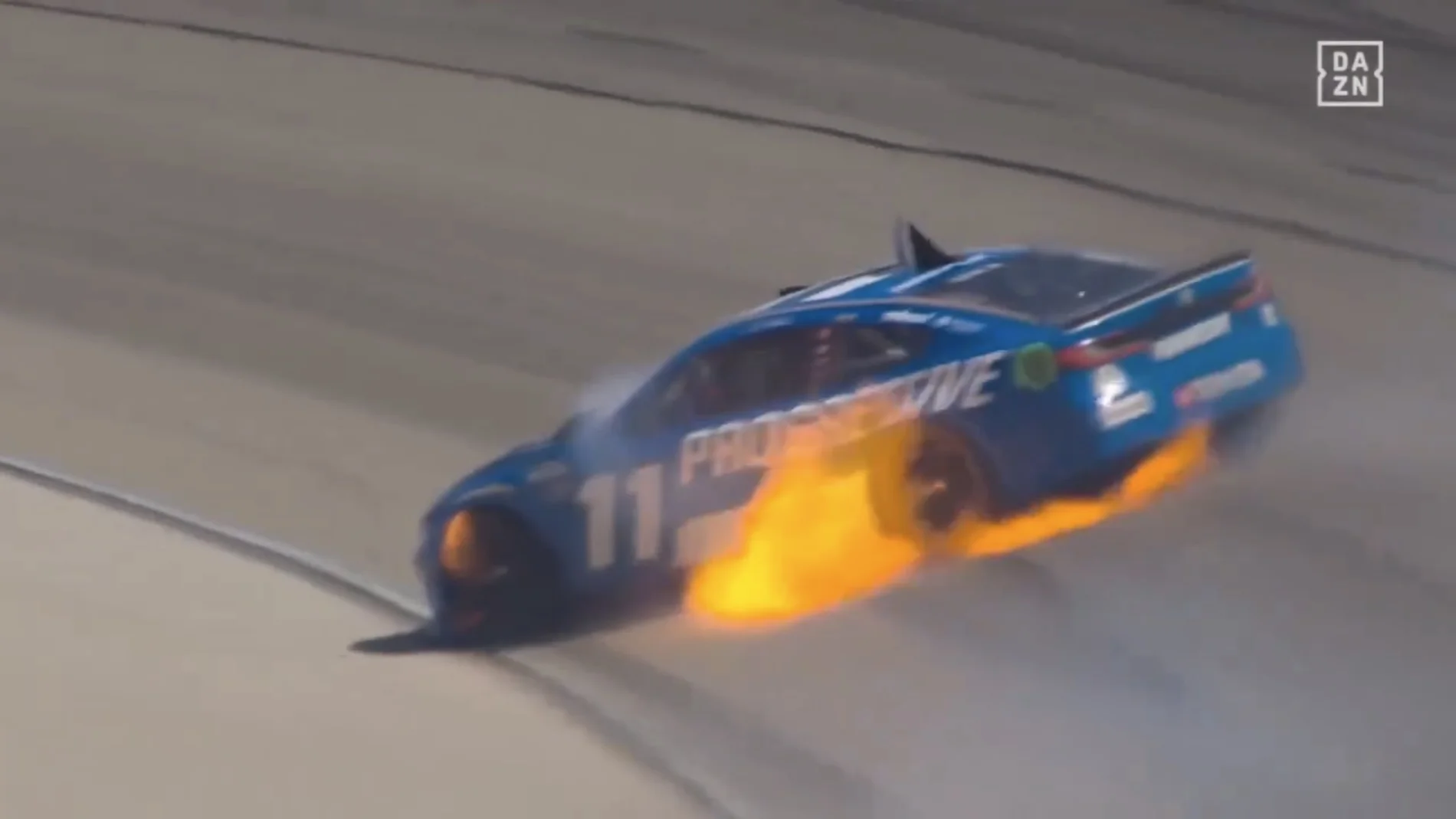
Denny Hamlin’s hopes at Texas Motor Speedway vanished in a burst of flames during Sunday’s contest, as NASCAR’s relentless chase for speed took a dangerous turn on lap 75. Piloting the No. 11 toyota/”>Toyota, Hamlin’s race came unglued when his engine erupted between Turns 1 and 2, thick smoke billowing into the cockpit and flames licking beneath the car—forcing Hamlin into a tense, desperate escape. The mishap shocked fans and competitors alike, leading to immediate questions about the risks being run in every high-speed lap. Hamlin described it as a “grim reality” of the sport, and in the stunned hush that followed, it became clear this was more than a routine failure: it was a stark warning about NASCAR’s ever-thinning margin of safety.
From the outset, Denny Hamlin appeared poised for success. He started the race with notable aggression, taking the lead by lap 24, signaling that the No. 11 was a force. But the promise soon disintegrated. On lap 22, a confusion over the team‘s “cowboy code word” derailed his pit stop strategy at a critical caution, as crew members talked over one another on the radio. Hamlin, momentarily unsure, stayed on track rather than pitting as planned, only to speed down pit road when he finally did come in—earning a costly penalty and dropping far back in the field. Despite doggedly reclaiming 10 positions by lap 64, that early error left him boxed into a perilous spot. As commentator Mamba Smith wryly noted,
“It didn’t matter to them. They were still going to blow up at that point, anyway.”
The disaster unfolded under green flag conditions. On lap 75, as Denny Hamlin powered between turns, the combustion in his Toyota seized violently—sending plumes of smoke and sheets of fire coursing through the machine. The footage replayed Hamlin’s harrowing delay as he scrambled from the oven-hot cockpit, ticking seconds that must have stretched into eternity for those watching, including his crew and family.
“You try to limit the damage and just get it back so the guys have something to look at. It’s frustrating,”
Hamlin later explained, his words thick with regret over yet another “grim reality.” Smith echoed fans’ terror:
“I’m glad he was okay because I felt like he was in that car for a long time for how much smoke was coming through.”
Safety crews arrived in moments, but the image of Hamlin fleeing from fire was a jolt—a reminder of motorsport’s inescapable peril.
Analysis swept the paddock as experts raced to uncover the cause. Kevin Harvick, drawing on his two decades of experience, did not mince words.
“It looks like it was a fuel fire, but sounds like they broke a valve spring, dropped a valve. And then it exploded. So it sounds like this was the third race on that particular engine, based upon the feedback that I got from Larry Mack. Those margins of speed are getting closer together, and when those margins of speed get closer together, they wind up pushing things a little bit further. … We saw this, what I thought was a valve spring issue last year with the Toyota engines, and they blew up three or four of them in a row.”
Harvick’s diagnosis pointed to a systemic problem—one feeding an urgent debate.
Harvick’s concern did not end there. Warning of the dangers embedded within the machinery, he explained,
“When you start hearing valve spring, that to me is terrifying … that comes with bad batches and then you start having these different batches of valve springs all over the place, so sometimes it’s hard to wrangle those problems.”
His words rang with the voice of experience and anxiety, highlighting not only a single malfunction but also the hidden threats lurking behind each engineering decision—especially as teams search for every last tenth of a second.
The race’s chaos was emblematic of the pressure on teams and drivers. Over 267 laps, there were 15 lead changes among 11 drivers, and 65 of those laps ran under 10 separate cautions. Carson Hocevar led from the pole, while Austin Cindric took control in Stage 1 and Kyle Larson snatched Stage 2. Kyle’s assertiveness gave way to Josh Berry’s surprise charge by lap 99, but even that ended violently as Berry crashed out on lap 125. Late cautions allowed Michael McDowell a brief moment in front on lap 251, yet attrition was the theme, with Joey Logano edging everyone out by lap 267’s checkered flag. In that relentless turmoil, Denny Hamlin’s fire was the harshest punctuation mark.
Joey Cohen, a respected NASCAR engineer, spotlighted oil or fuel system breakdowns as possible causes, but the valve spring theory gained traction quickly among insiders. Cohen reflected,
“The exhaust used to run the full length of the rocker panel, so we used to exit the exhaust in front of the rear tires. What we come to find out there was those exhaust pipes under the driver were carrying a large amount of heat and just soaking that underside of the chassis, basically cooking the drivers.”
The specter of history haunted the moment, reminding some of the fire that nearly destroyed Rick Mears at the 1981 Indy 500—a time when invisible methanol flames leapt unseen through pit lane. For Denny Hamlin, at least, the blaze was terribly real, and thanks to newer safety standards, disaster was narrowly averted.
Even with the physical threat behind him, the psychological and tactical wounds ran deep.
“You boys were talking over each other, and I heard ‘Cowboys,’ and obviously I looked at my card,”
Hamlin radioed in frustration, after the pit stop missteps compounded his woes. The communication breakdown illustrated just how quickly chaos can erase months of preparation, and on Texas’s unforgiving high-speed stretches—where “dirty air” blocks overtaking—such a mistake is rarely survivable in championship terms. Analysts diagnosed near-impossible odds for Hamlin’s comeback, intensifying an already devastating setback.
Those code words, designed to evade rival teams and protect strategy, now seemed more hindrance than help. Kevin Harvick was candid on his podcast.
“I hate the code words. I know a lot of them use the code words. I feel like it’s follow the leader in some of those scenarios. I never like—we s—— the code word up one time, and I’m like, ‘We’re done with code words.’ Just tell me when to pit.”
Harvick’s voice cut through the static—a veteran’s plea for clarity and fairness at a time when technical gamesmanship appears to be hurting more than helping.
The result was more than a busted engine or lost points. The spectacle of Denny Hamlin scrambling free from the burning Toyota left fans rattled and divided. Some hail his resilience and hope for a heroic rebound, while others echo Harvick’s call for honesty and safer racing. On social media and at trackside, the memory of flames and smoky confusion reignited a simmering debate about whether NASCAR’s obsession with squeezing every last ounce of speed has tilted too close to the edge. Can teams continue shaving reliability to hit marginal gains, or has the sport reached a flashpoint where safety must prevail over ambition?
Even as the official review focused on technical details, the emotional fallout lingered. Hamlin, a championship-caliber driver, maintained composure post-race, determined not to let setback turn into defeat. His bond with crew chief Chris Gayle has weathered storms before, but this episode was an unmistakable warning.
“We’re going to regroup and come back stronger,”
Hamlin has said in seasons past, but even the most seasoned drivers feel the weight of survival after such a close call.
The Texan spectacle reinforced that NASCAR, even in its Next Gen era, remains a precarious balance of speed and survivability. Mechanical failure, exacerbated by communication snafus, can turn a would-be title run into an inferno—and the human toll is never far away. Multiple analysts have pointed to the pressure created by shrinking speed margins; as teams edge closer together in performance, the temptation to push tolerances has grown, and the result is a playing field where the smallest flaw can have catastrophic results for someone like Denny Hamlin.
The events in Texas also reignited historical comparisons, reminding fans how recent advances—flame-retardant suits, improved fire suppression, and safer chassis—have saved lives. In older eras, as with Rick Mears’ gruesome pit fire, such accidents sometimes proved deadly or career-ending. NASCAR, to its credit, has continually evolved safety measures, but Hamlin’s scare underscored that no safety net is invincible. The debate now swirling around pit lane and fan forums is less about blame than about reckoning—how much risk remains acceptable in the ceaseless quest for advantage?
At the heart of this firestorm are tricky technical questions. Is the current push to run engines across multiple races—a cost-saving measure—unintentionally raising the likelihood of catastrophic mechanical failures? Are teams like those supporting Denny Hamlin forced into tighter windows of reliability just to remain competitive? When the communication breakdowns occur at 180 miles per hour, there is little time for error correction, and as Sunday demonstrated, the consequences can be dire.
Still, amidst the wreckage of a race gone wrong, hope flickers for Hamlin and his fans. The No. 11 remains a perennial contender, and Hamlin’s skill under pressure isn’t diminished by misfortune—if anything, it is highlighted when he chooses to confront adversity head-on. Texas was a bitter chapter, but with a re-focused team and hard lessons learned, Denny Hamlin’s presence in the title hunt endures. The engine fire and pit stop circus may haunt this season’s narrative, yet they have also lent new urgency to calls for introspection—and perhaps reform—inside NASCAR’s high-octane universe.
Harvick’s reflections, delivered with the gravitas born of survival, may well shape that conversation.
“We saw this last year with the Toyotas,”
he noted, recalling patterns that could become more frequent as teams push hardware to its breaking point while communication overlays fail under stress. His call for transparency is a rallying cry for returning to fundamentals—where telling a driver when to pit is a matter of safety, not subterfuge. In a race where the difference between glory and disaster is measured in split seconds, clear communication may soon prove as essential as horsepower itself.
Looking ahead, Denny Hamlin must put this fire behind him and reassert his form—mentally as well as physically. Championship aspirations can be upended in an instant, but resilience has always defined Hamlin’s brand. Yet Texas left scars, not simply on the car or in the standings but within the entire NASCAR ecosystem, as drivers and decision-makers reckon anew with the forces they unleash in pursuit of speed. Each lap and pit stop now carries a heightened awareness that disaster is rarely more than a heartbeat away.
For NASCAR, the debate grows louder: Has the drive to extract every ounce of performance crossed into unacceptable territory, imperiling drivers for incremental gains? Hamlin’s ordeal may mark a pivotal tipping point, capturing both the promise and peril of racing at its highest level. As the dust settles over Texas Motor Speedway, teams, officials, and fans alike must reconcile their love of high-speed drama with the sober reality that behind every victory celebration is a shadow of risk—and that, for Denny Hamlin, the line between routine and tragedy was never thinner.