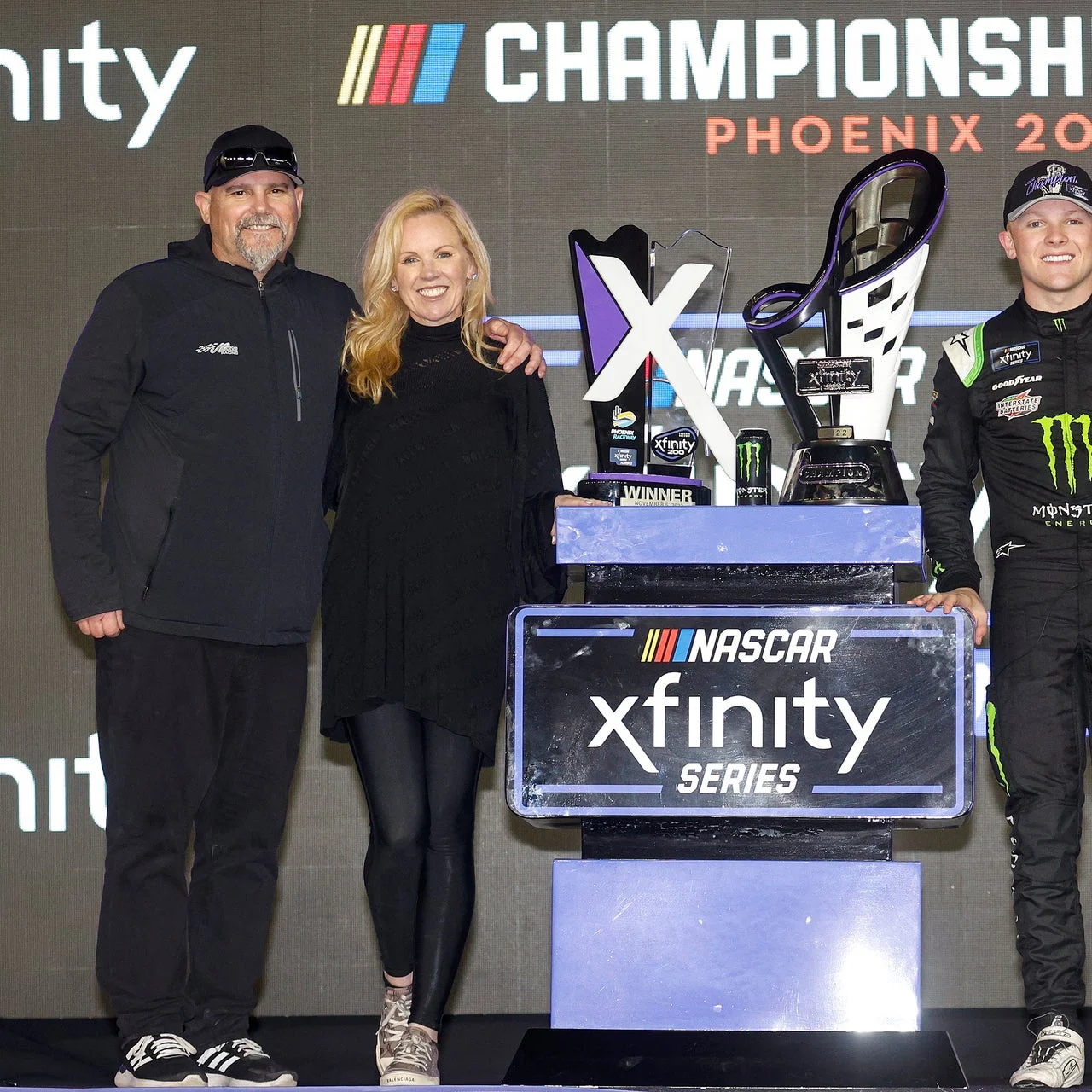
In a deeply emotional moment that has drawn widespread attention from fans and the NASCAR community alike, Joe Gibbs and his family are once again facing an intensely personal loss. On May 6, 2025, Ty Gibbs, the promising young driver and grandson of NASCAR legend Joe Gibbs, shared heartbreaking news with his followers. Through a pair of succinct and poignant Instagram stories, Ty announced the passing of his beloved dog, Lulu. As racing enthusiasts and fellow drivers rallied around the Gibbs family, the tragedy underscored the profound connections that often exist between athletes and their cherished companions, reminding many how loss can reverberate well beyond the racetrack.
Joe Gibbs, a name synonymous with excellence in American motorsport, has endured more than his share of personal trials. The latest sorrow gripping the Gibbs family follows a series of emotional blows for Ty, who has now lost a second beloved dog in the span of just two years. With heavy hearts, the Gibbs family and their supporters navigate a season shadowed by grief, yet marked by public displays of unity and understanding from the wider community. The loss of Lulu comes not only as a familial blow but as another layer of adversity in a racing season already fraught with challenges for Ty—a season shaped by struggles on and off the track.
For competitors like Ty Gibbs, pets are more than mere four-legged friends—they are steadfast companions, sources of solace, and irreplaceable family members. The bond between drivers and their dogs is perhaps best understood by those who have witnessed the demanding, often isolating lifestyle of professional racing. Throughout the endless weekends and across the miles from one raceway to another, these faithful animals offer comfort that cannot be quantified. Their presence becomes a crucial anchor, helping athletes manage the pressures that come with living life at breakneck speed. Joe Gibbs, renowned for building teams defined by both talent and tenacity, recognizes just how profound the pain of such a loss can be for the young driver he has mentored closely.
The sporting world has long acknowledged the restorative power of pets. In 2017, Dale Earnhardt Jr. famously paid tribute to this bond at New Hampshire Motor Speedway, spotlighting a fan’s dog, Marshall, on his own racecar. Through that simple gesture, Earnhardt Jr. reminded everyone that amid the roar of engines and the relentless race for victory, there exists a quieter, deeper connection fueled by loyalty, affection, and mutual support. Photos of drivers reuniting with their dogs after exhausting race weekends are a common sight, revealing just how much these relationships mean, especially in an environment fueled by adrenaline and intense competition.
Ty Gibbs’s relationship with Lulu was no different. In racing, where fortunes can shift with the roll of a tire and the outcome of a race can hinge on mere fractions of a second, Lulu provided stability and unconditional affection. Ty’s tribute was short but searing—“Lost a great friend today” and “love u Lulu”—capturing the sharp pain of the moment. The simplicity of his words spoke volumes, resonating not only with fans but with anyone who has endured the heartache of losing a beloved pet. Messages of support flooded his social media, revealing just how many people could relate to his grief. For Ty and the wider Gibbs family, Lulu’s passing served as another reminder that life’s most wrenching losses often occur away from the public eye.
Yet, for Ty Gibbs, this heartache is all too familiar. Less than two years ago, in 2023, he faced another devastating blow with the death of Bronson, his previous canine companion. Ty’s reflections on Bronson—
“Bronson was always there. We walked together, played together… He helped me get through a lot”
—offered fans a glimpse into the importance pets hold in the daily lives of athletes. The memories of shared walks, moments of play, and quiet companionship became bittersweet after Bronson’s passing, and now echo in the memories Ty shared with Lulu. Whether navigating victories or setbacks, these bonds represent a source of unwavering comfort, particularly when the demands of racing seem overwhelming.
Among their peers, the Gibbs family’s openness about grief has been both illuminating and courageous. The racing paddock has endured similar tragedies that touch everyone within its close-knit community. In 2024, a somber incident involving Chip Ganassi and Devlin DeFrancesco’s golden retriever, Lucky, at Daytona shocked the motorsport fraternity. Ganassi’s immediate, heartfelt apology and his subsequent donation to the Indianapolis Humane Society demonstrated not only remorse but a shared empathy that extends through the racing world. DeFrancesco’s own words—
“Nothing will bring Lucky back… but thank you to Chip for his donation”
—highlighted the profound sorrow such losses can inflict, no matter the circumstances.
Tragedy, in its many forms, can take an enormous toll, both emotionally and professionally. For Joe Gibbs and his family, the weight of these successive losses, including the earlier passing of Ty’s father, Coy Gibbs, feels almost insurmountable. The NASCAR community, however, has consistently proven resilient, bands together in times of adversity, and emerges stronger. Even with the sport’s frenetic pace and the ever-present glare of public scrutiny, moments of vulnerability like these reveal the human side of those who stand atop the podium or wrench beneath the hood. The Gibbs family, seasoned by experience and bonded by love, carries on—each member a testament to perseverance in the face of deep sorrow.
On the professional front, the pressures have been mounting for Ty Gibbs. Entering the 2025 season with high hopes, he has found the path to success increasingly complex. After eleven races, his record includes one top-five and three top-ten finishes, a disappointing slide from his ascendant performance in 2024—when he earned twelve top-ten races and a respectable fifteenth-place finish in the year-end standings. The contrast is stark. Where last year’s campaign suggested consistent progress and maturity, this season has been marred by inconsistency and misfortune. Accidents at Atlanta and Phoenix, as well as frustrating mid-pack finishes, have added to the challenges Ty faces not just as a racer, but as a young man carrying extraordinary personal grief.
Speculation naturally arises as to how off-track adversity might be affecting Ty’s competitive edge. Racing with a heavy heart is no easy feat, especially for a driver as young and ambitious as Ty Gibbs. The mental fortitude required to perform at the highest level is considerable, and compounded grief can quickly erode confidence. Racing is a sport that demands relentless focus, yet often punishes the smallest of lapses. For Ty, every turn of the track now carries an additional weight, a silent reminder of both the family he’s lost and the expectations he still strives to fulfill. The absence of Lulu, like the empty seat beside him after Bronson and his late father, is as palpable as the roar of engines on a Sunday afternoon.
Yet even as he copes with personal tragedy, Ty Gibbs has shown remarkable resolve in standing up for himself and the wider NASCAR community. Recently, Ty made headlines with his candid take on fan scrutiny regarding drivers’ heated radio exchanges. In response to the uproar following Joey Logano’s impassioned broadcast critique at Talladega, Ty offered a pointed defense of competitors’ right to emotional expression.
“That radio is for your team, and the only reason why anybody else has access to it is for entertainment. We are an entertainment business, but also, I think we get made out to look like bad people at times for what we say on the radio or what happens,”
Ty remarked, speaking to Frontstretch.com.
His statement underscored an important truth: while racing broadcasts offer unparalleled access to athletes, they often strip away context, turning private, heat-of-the-moment exchanges into public spectacles. Ty continued,
“If any of us drivers put radios inside of somebody’s car going down the highway, I think that a lot of people would probably be in way worse trouble than we would… And I think that’s something everybody should understand.”
Through his words, Ty offered a rare glimpse into the raw humanity that underpins every lap and every race-day decision, asking fans for empathy rather than condemnation.
This perspective from Ty Gibbs does not come from mere frustration, but from lived experience. The pressures he feels are amplified not only by expectations of performance but also by the weight of family legacy. Joe Gibbs, after all, is a figure whose accomplishments span decades and whose influence over motorsport can hardly be overstated. To carry such a storied name can be both a privilege and a burden, especially when compounded by personal grief and public scrutiny. Ty openly acknowledges that mistakes will happen, both in words and in deeds, but insists that these moments should be understood within the context of immense pressure and relentless competition.
The reverberations of these losses are not limited to just Ty Gibbs or his grandfather, Joe Gibbs, but ripple out across the entire spectrum of NASCAR. Teammates, fans, and even rivals have rallied in support, offering messages of condolence and solidarity. Social media platforms have become conduits for shared grief and collective healing, as the motorsport world acknowledges the pain of one of its own. For young fans and aspiring racers, the situation offers a sobering but vital lesson about the realities underlying the glamour and prestige of professional racing—loss, heartbreak, and resilience are often the true measures of greatness.
As the season continues, the pressure for Ty Gibbs is matched only by his determination to honor both his family and his lost companions. While the standings fluctuate and the headlines shift with every race, the underlying story remains one of resolve and the power of familial bonds. Joe Gibbs, having weathered countless storms over a lifetime in sports, remains a pillar of support for Ty and the greater Gibbs family. Their ability to navigate adversity, offering each other strength and understanding, serves as a powerful example not only to NASCAR but to anyone facing their own trials.
Looking ahead, it is clear that the story of Joe Gibbs and his family will be defined by more than wins and losses on the track. The emotional endurance demonstrated by Ty and those around him will shape both his racing destiny and his legacy. As tributes to Lulu continue to pour in, and memories of Bronson linger, Ty’s journey becomes emblematic of the countless ways in which hardship and hope are intertwined in sports and life. The path forward may be uncertain, but the solidarity surrounding the Gibbs family assures that no loss, however great, will dim their lasting impact on the world of racing.
Ultimately, the tragedy experienced by Joe Gibbs, his grandson Ty, and the wider family has brought the reality of grief into sharp focus for the broader public. The loss of Lulu, while personal, has touched thousands, uniting fans in compassion and reminding everyone that victory is not always about who crosses the finish line first. Sometimes, true victory is found in the strength to keep moving forward, to cherish the memories of what has been lost, and to find meaning even amidst sorrow. As the NASCAR season unfolds, the example set by Joe Gibbs and his family will continue to inspire, revealing that the greatest stories in racing are written not only in speed and success, but in the courage to endure and the grace to remember.