
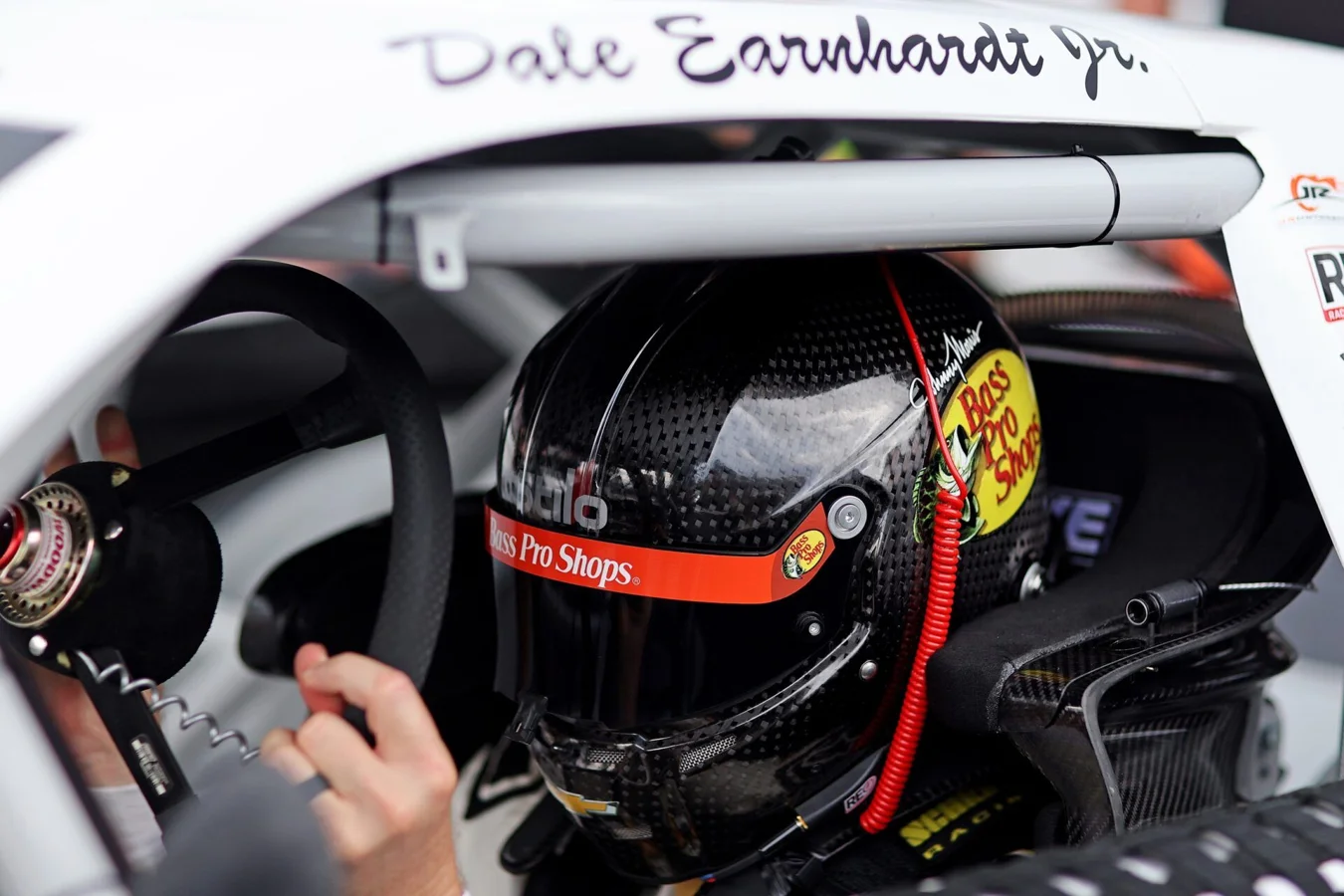
During a recent episode of his Ask Jr. podcast, Dale Earnhardt Jr. unveiled the crucial purpose of the tape strips seen on NASCAR Cup Series steering wheels, highlighting how minor details like the placement of Dale Earnhardt Jr. steering wheel tape give drivers and crews a technical edge. These markings hold dual significance—they not only help diagnose car issues mid-race, but also allow pit crews to execute lightning-fast tire changes when every second matters.
The presence of these small, colored strips has long intrigued fans, but as Earnhardt explains, their function can be the decisive factor separating front-runners from the rest of the field. By decoding this practice, Earnhardt exposes the persistent and sometimes overlooked search for every possible competitive advantage in one of motorsport’s most demanding leagues.
How Center Tape Aids Damage Detection During the Race
When asked about the steering wheel tape by a fan during his recent podcast, Earnhardt offered a clear explanation:
So, there’s obviously the center mark that’s always kind of been there to help a driver understand where the center is,
—Dale Earnhardt Jr., NASCAR Driver
Originally, this central tape stripe existed primarily to help drivers realign their wheels if they lost control or spun out on the track. However, the purpose of this tape has changed over time. Now, according to Earnhardt, it acts as a quick visual check for possible suspension or toe link damage:
That’s not only- I mean, that used to be helpful when we would bust our ass and spin out and we’d need to kind of get the wheel straight and get it,
—Dale Earnhardt Jr., NASCAR Driver
Expanding on its modern use, Earnhardt noted:
But now I think you use it to tell if you have a bent toe link or any kind of toe damage. You’re driving the steering, you know, and you’re driving, you can see it’s offset a little bit. It’s just a thing,
—Dale Earnhardt Jr., NASCAR Driver
During a race, drivers like Earnhardt will frequently check the tape mark relative to the top of the steering wheel as they drive straight. If the tape shifts left or right from its center position, it flags possible bending or failure in suspension components. This immediate visual cue can be the difference between catching a problem early and suffering a sudden mechanical failure that knocks a contender out of the race, showing just how unforgiving the Cup Series can be for both drivers and crews.
Pit Stop Precision: Why Extra Tape Marks Matter
The significance of Dale Earnhardt Jr. steering wheel tape doesn’t end with suspension checks. Precision becomes even more critical during pit stops. Here, tape strips at the 1 and 11 o’clock positions serve as vital guides for the pit crew and driver. Earnhardt explained this lesser-known detail:
There’s other marks on the steering wheel at kind of like the one and the 11 o’clock. So, those are where you need to have the steering wheel to be able to change tires on the pit stop,
—Dale Earnhardt Jr., NASCAR Driver
His longtime spotter, TJ Majors, highlighted how tire changers depend on these marks for efficiency:
Yeah, that’s different tire changers to get the tire off. Sometimes you need to a little bit to the right, you go to the left side.
—TJ Majors, Spotter
Because of the exacting geometry of Cup Series vehicles—tight wheel wells, aggressive cambers, and constrained openings—drivers must turn the wheel slightly to allow proper access for the pit crew’s impact guns. The tape guides are set so that when changing tires on one side, the wheel is pre-turned to create needed clearance; for the other side, the wheel is turned in the opposite direction. Not having these markers could cost precious time—possibly the race itself. As Earnhardt reinforced:
Due to the geometry in the front and the casters, cambers, and all those things and how tight the wheel openings are,
—Dale Earnhardt Jr., NASCAR Driver
He made the process clear:
When you come to pit road, for the right side tire changer, you cock the wheel a little bit, so you can get the wheel off and on. And then when they come around the left, you cock the wheel the other way, so they can get the wheel off and on.
—Dale Earnhardt Jr., NASCAR Driver
This coordination between driver and pit crew, supported by these simple tape marks, can shave critical tenths of a second off pit stop times, frequently altering the final race outcome. Any failure or hesitation, in the relentless pressure of pit road, spells disaster for contenders vying for position.
Minute Details That Separate Winners from the Pack
Dale Earnhardt Jr.’s insights, backed by TJ Majors, expose the underlying tension and obsessive attention to detail that defines the world of NASCAR. Marks most fans mistake for decoration—like the Dale Earnhardt Jr. steering wheel tape—actually function as a lifeline, ensuring that drivers can both identify mechanical issues instantly and work in perfect unison with their pit crews during tire changes. The role of tire changers, spotters, and everyone involved in these high-pressure moments is magnified by this visual system.
By drawing back the curtain on this subtle yet critical technique, Earnhardt demonstrates how even the simplest innovations can redefine what separates a true contender from a backmarker. In an environment where every millimeter and millisecond counts, the strategic placement of steering wheel tape offers drivers and pit crews a silent—but decisive—edge in one of racing’s fiercest battlegrounds.
Our Reader’s Queries
Q. Is Dale Earnhardt Jr. a billionaire?
A. By 2025, Dale Earnhardt Jr.’s net worth is about $300 million. His wealth comes from his successful NASCAR driving career and continuing job as a broadcaster. He also stays involved with endorsements, owning a team, and forming partnerships, which have increased his impact.
Q. Is Dale Earnhardt Jr. retiring?
A. In 2017, Dale Earnhardt Jr. decided to stop racing full-time after being a NASCAR Cup Series driver for 17 years. He was 42 years old and had experienced several concussions during his career.

