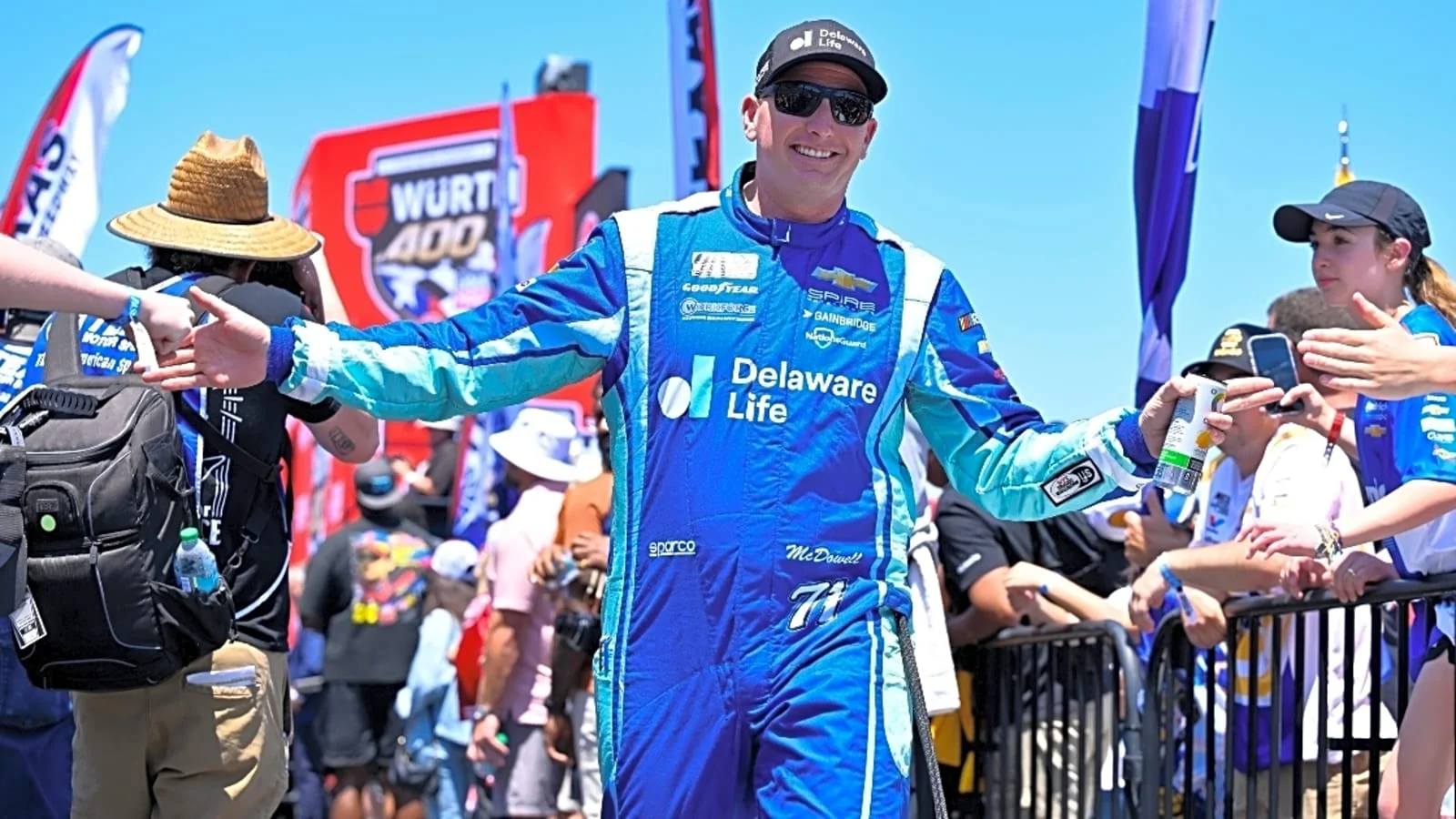
Michael McDowell is preparing for a pivotal double-duty weekend at Watkins Glen International, where the stakes are at their highest for the NASCAR Cup and Xfinity Series events. During his Watkins Glen media session, McDowell candidly discussed his determination to take control of his own destiny, sharing both optimism and urgency ahead of the races where a win could define his season.
McDowell Prepares for Double-Duty Challenge
As the driver of the No. 71 Spire Motorsports Camaro ZL1 and the No. 11 Kaulig Racing Camaro SS, Michael McDowell returns to Watkins Glen with added responsibility, contesting both the Cup and Xfinity Series races. McDowell emphasized the excitement and nerves of jumping into the Xfinity car, especially because it has been years since his last appearance in the series. Recalling his preparation, he said:
“Yeah, it’s been a long time, so it’s been exciting. Yeah, it’s been fun. I haven’t driven the car yet, but just, you know, the prep work and some of the simulator work and yeah, it’s nerve racking too, just because the cars are very different than the Next Gen Cup cars. But, you know, thankful for the opportunity and I’m glad to get some, you know, more reps and, you know, last time I ran, Xfinity car was Road America 2016 and felt like, man, I’m not going to get it in one of these things again unless I could win, and I feel like this is a car that I can win in. So, I’m excited to give it a shot.”
—Michael McDowell, NASCAR Driver
For McDowell, competing in both series at the Glen represents a rare opportunity to maximize on-track time, building momentum for the season’s critical closing stretches.
Watkins Glen: A Defining Race for Cup Series Playoff Hopes
The intensity surrounding Watkins Glen is not lost on McDowell, who recognizes the race as a potential turning point in the pursuit of postseason qualification. He was clear about the stakes when asked about what this weekend means for his ambitions:
“It’s do or die for sure, yeah. I mean, yes, we have more opportunities. I mean, we’re not we can go to Richmond and run well too, and obviously, Daytona, I feel like we have a shot at it. But to me, this is the only way you control your own destiny is to win here. The other two are very tough to execute and have everything go your way, so times winding down, as you guys know, right? And, the pressure always ramps up as the times winding down, but I’ve been in the spot before, and, yeah, definitely feel confident that our road course programs, you know, been really good. And if we do our job and we have a fast car and we qualify well today, and we can start up front, we we’ll have a shot at it.”
—Michael McDowell, NASCAR Driver
The urgency in McDowell’s message is clear. With the NASCAR playoffs nearing, winning at Watkins Glen is the surest strategy to ensure a berth, given the challenges of succeeding at upcoming venues like Richmond and Daytona. Past experience in pressure situations gives McDowell a sense of confidence, though he acknowledges the mounting pressure as the season progresses.
Recalling a Career-Altering Victory
Reflecting on his memorable 2016 win at Road America in the Xfinity Series, McDowell shared how that victory shaped his mindset and highlighted the highs and lows of racing. Addressing how that day affected him, he recounted:
“Yeah, it was it was a great moment. There’s a lot of funny stories. You know, I’d driven the Gibbs car a couple years prior to that at those places and sat on the pole and led the most laps and had shots at winning and just never got to the finish line. You know, green/white/checkers or fuel miles or whatever it is. and with the RCR group, I had one race, you know, sort of one race, one shot, and it all worked out. Just a good execution all day and no problems, and kind of like how you dreamed it up to be, where, you know, the last several before that that Gibbs cars, like, I probably had more speed and more of a dominant day, but it just didn’t work out, so to have it all finally come together was a big relief, honestly, just because it had been, you know, such a long time and so close. But just a funny part of, you know, the journey there is Sam Hornish was practicing qualifying my car in Michigan, my Cup car. And so, you know, he ran the car Saturday, and I obviously won the race, flew back to Michigan, and I talked to Sam for a little bit, and honestly, he just personally did me a favor of practicing qualifying that car. It’s not something I think he truly wanted to do. And I said, How was it?”
—Michael McDowell, NASCAR Driver
Sam Hornish’s response was telling:
“Man, I know it’s probably me, ’cause I haven’t driven, but it’s so bad. I remember thinking, Oh, it can’t be that bad, right? It’s going to be okay.”
—Sam Hornish, NASCAR Driver
This story exemplifies not just the contrast between the peak moments and humbling experiences that define racing, but also McDowell’s resilience in navigating setbacks. He recounted how quickly the thrill of victory on Saturday gave way to a tough race on Sunday and how important the support and recognition from peers felt during that period.
Confidence and Momentum at Watkins Glen
Addressing his outlook for the upcoming events at Watkins Glen, McDowell provided insights into how confidence and momentum play a role, particularly on road courses where he’s shown speed:
“Yeah, confidence is, you know, is interesting. We talk about a lot of our sport, and it’s a real thing. But I think momentum’s more of a real thing than confidence, and they correlate, they go together. I mean, I think I show up every weekend feeling like I can win. And, you know, obviously, the real courses are a little bit more pep in our step just because they’ve been our strength, and that’s more of the momentum, you know, when you run top five, most of them, you know that you have a fighting chance at it. And, yeah, but with confidence, I’ll say this, is that, you know, I showed up as Sonoma, thinking after Chicago, that we were gonna be the car to beat, and we weren’t. And that’s how finicky Cup racing is. We still ran well. We still ran in the top five, but we didn’t have the outright pace that we needed to do what we needed to do at Sonoma. But we come in here confident that we got it all right, and that we will. And so I feel like we this is probably our strongest track as a group last year, you know, all three Spire cars were in the top ten, and, you know, individually, even though the results won’t show it, this is probably my best track from an outright speed standpoint. You know, we’ve had an engine failure and a bunch of issues over the last three years, but let a lot of laps and been out front a lot here, so confidence is high. But you got to execute, and you know, you got to hit everything just right.”
—Michael McDowell, NASCAR Driver
He revealed that his trust in his team and the recent progress made with Spire Motorsports road course setups are strong motivating factors heading into the weekend. While past technical problems have hampered results, McDowell is quick to point out that outright performance at Watkins Glen has been excellent when issues are avoided.
Adjusting to Evolving Road Course Strategies
McDowell detailed how the team’s approach to road course racing has evolved, requiring a significant departure from previous methods. Explaining the shift in philosophy and the value of steady, incremental improvements, he stated:
“Yeah, it’s not even close. Um, I sort of we sort of had to abandon that ship fairly early on of what we used to run versus what we run now. It just hasn’t worked. I think we’ve talked about that a few times, so we went to the mindset of this is gonna be a slower building process, than we had hoped, but it’s actually worked out because we, you know, we went to COTA and learned things there, and then, you know, I kind of transferred over into Mexico and felt like we made a next step, and then went to Chicago and made a next step, and then went to Sonoma and took a step back, and hopefully we’ve made that next step back forward. And so just slowly building that package around me and around the baseline that they’ve had, which is very different than what I’ve ran the last two years.”
—Michael McDowell, NASCAR Driver
This slow but deliberate adjustment reflects the competitive evolution within NASCAR road racing, as teams work to keep pace with changes and advancements in both the Cup and Xfinity Series. Building the right car setup for unique tracks like Watkins Glen is essential, especially as teams like Spire continue to refine their approach alongside other leading organizations.
Critical Track Features and the Search for Speed
Watkins Glen’s layout provides its own set of challenges, with certain track features impacting qualifying and racing in distinct ways. McDowell broke down his approach to dial in performance in practice:
“Yeah, it’s different here for the race than it is for qualifying, what you’re looking for, I should say, because we’re a lap time and speeds made is not necessarily where passing’s made. So, it’s a little bit of two different things. I mean, you got to be good in all the corners, you don’t have any room for throwaways, but, you know, your lap time and your speed’s going to come from the esses. The esses and the bus stop. But you don’t pass so much there, you pass into turn one and you pass into turn six. And so, for this practice here, you’re focusing on both of, what do I need to make, you know, ultimate lap time and am I good in these areas leading up to the passing zones? So, it is unique from that standpoint where some of the other tracks are more straightforward of where you need to be strong. This, I think, is different for lap time than it is for race.”
—Michael McDowell, NASCAR Driver
This technical analysis underlines the importance of mastering both raw pace and racecraft at pivotal overtaking points, such as turn one and turn six, in order to maximize results at the Glen. Fine-tuning both aspects in practice is a balancing act for drivers targeting victory on the iconic New York road course.
Understanding the Edge Held by Consistent Winners
Recent road course success by Shane van Gisbergen has been a topic of interest, considering the information-sharing practice across teams and the data-heavy world of modern NASCAR. When asked about the challenges in replicating such dominance, McDowell compared raw data to fitness routines, emphasizing the gap between theory and practice:
“Yeah, I mean, I would relate to this just because, um, you know, social media or Instagram, you see somebody working out on lifting weights, doesn’t mean that you know how to get fit. It’s kind of the same thing with data, is you can look at it all you want, and you can say, I need to do this, but actually doing it is different. You know, your muscle memory and having the car set up in the feel and, you know, all the uniqueness to a driving style. You know, the guys that talk about that were Denny and those guys that, you know, had a clear advantage in the old car and short tracks, Denny’s phenomenal with saving tires and all the things he did. So there was maybe a few little trade secrets that you could learn, but as we’ve seen, going and doing what he did there’s still hard to do, right? And so you can see the data, but duplicating it and duplicating the feel and you’re not driving their car as well. You don’t know what their setups are, you don’t know, you know, what they’re doing, that allows, you know, a person to approach it like that. So, it gives you, it gives you an area to work on. It gives you an area to identify, okay, this is where I’m getting beat. How can I get better?”
—Michael McDowell, NASCAR Driver
This perspective highlights the limits of information and the critical role of feel, car setup, and individual driving style in achieving repeatable success. Even with identical cars and shared information, subtle differences in execution often separate winners from the rest of the field, a reality recognized by both drivers and teams like Spire and Trackhouse Racing.
Spotlighting Emerging Talent and McDowell’s Continuing Legacy
The success of young drivers, such as Tristan McKee’s recent win, prompted McDowell to reflect on his own journey and the unique demands facing newcomers to the sport. Drawing parallels with rising talents like Joey Logano and Kyle Larson, he spoke about the pressure and importance of giving young talent an appropriate runway:
“Yeah, not winning at Watkins Glen. Yeah, it’s really awesome to see and, you know, obviously, we’ve invested a lot into seeing the potential and where it could go, and at a young age, it’s so hard. It’s hard because. I would say if you just look at, like Joey Logano, you look at Kyle Larson, you look at all the young guys at that 14, 15, 16 age, they were dominant in everything that they did, but as you take that next step and next step and next step, it just gets harder and harder and harder and, you know, obviously, he rose to the occasion yesterday, and, you had things go his way, for sure. I mean, Brent Cruz was, you know, pretty dominant all day, but he put himself in position and he executed and to do that at 15 years old is extremely hard with a tremendous amount of pressure of it being his first race, so it was really cool to see. You know, it was it was a fun moment, too, you know, for me, because, you know, obviously I’m vested here at Spire and plan on being here a long time, and we’ll have a part in picking my replacement, which it looks like my replacement’s been picked, and the faster he gets through all these series, the faster I’m gonna be out of the seat. So it was a little bit of those moments of like, I still like driving. If this guy keeps doing this, this is gonna be really short for me. But, no, I mean, I feel like it’s great. And to have, you know, depth of young talent is super important, and, you know, I think the sky’s the limit, and it’s just gonna be about putting him in the right situations, and then also, too, you know, you got to be careful not to rush it, and, um, it’s easy for us to all do that, because of yesterday, right? I mean, we’ve seen it in our sport before, it’s like, ah, and then you just keep rushing it, rushing and rushing it, and sometimes that makes it a little bit too much, because you don’t get all the fundamentals that you need to progress to the next level. So, the good news is, is there’s a plan in place, and he has a lot of time available to him, right? And so it’s really not a rush because of how far ahead he is. And so, yeah, it was very cool to watch.”
—Michael McDowell, NASCAR Driver
In referencing adequate support and mentorship, McDowell underscores the value of developing foundational skills, even as the sport’s youngest competitors deliver breakthrough performances at venues like Watkins Glen. The nurturing of future stars such as Tristan McKee and Brent Cruz represents both the evolution of the sport and the continuity of racing tradition at Spire and across NASCAR.
Looking Ahead: High Stakes and Lasting Impact at Watkins Glen
The forthcoming races at Watkins Glen International stand as a critical juncture in Michael McDowell’s season and possibly his career. Having openly shared the emotional highs, setbacks, and hard-won lessons of his NASCAR journey, McDowell’s approach balances the need to seize the moment with an appreciation for the long-term development of talent and team alike.
With playoff hopes on the line and an intense focus on executing at one of his best tracks, McDowell is set to battle the field, write new history for Spire Motorsports, and perhaps secure a landmark victory during a double-header weekend. Meanwhile, the emergence of young racers and continued innovation by organizations such as RCR, Trackhouse Racing, and Spire underscore NASCAR’s relentless pace, reinforcing the significance of Watkins Glen as a focal point for ambition, redemption, and legacy.