
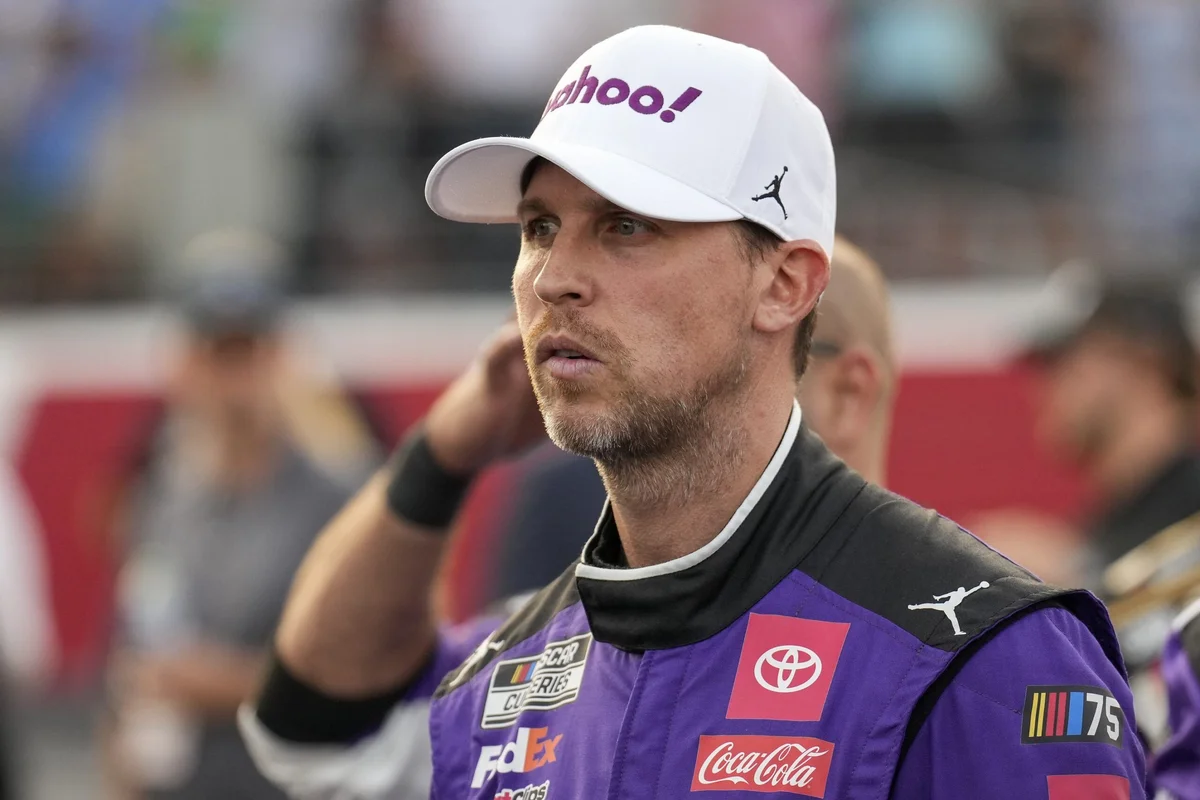
The antitrust trial continued with Denny Hamlin antitrust trial testimony taking center stage, as the NASCAR driver revealed personal and financial stakes behind his claims. On the second day of proceedings, the courtroom scrutinized Hamlin’s detailed grievances, painting a picture of mounting frustration and conflict within the sport’s inner workings.
Hamlin, one of NASCAR’s top-tier drivers and a 40% co-owner of 23XI Racing, spent over three hours on the stand defending his organization’s position. He explained that he brings in approximately $14 million annually for driving, yet his focus as an owner remains grounded in advancing racing’s long-term future. Hamlin revealed an initial investment of $45 million into 23XI Racing, with more than $10 million personally contributed and the rest covered by loans. He also highlighted his business acumen, sharing that while he projected a $900,000 profit for the team’s debut year, they far surpassed this, clearing over $3 million in 2023.
Ownership and Investment Disputes Come to Light
Courtroom debate expanded to Hamlin and Michael Jordan’s $35 million investment in the new team facility, known as Airspeed, which opened in 2024. NASCAR’s attorney, Lawrence Buterman, pressed Hamlin on an apparent budget discrepancy, suggesting the original outlay was closer to $9–10 million and accusing him of overspending—even raising questions about company holiday-party costs. Hamlin stood firm, stating the initial budget predated COVID-19 and didn’t account for full outfitting expenses in the finished facility.
The discussion grew more intense when Buterman questioned the $205 million in damages sought by 23XI Racing, referencing internal dialogue that had deemed a 10% return satisfactory. Hamlin deferred to expert testimony for those projections. The cross-examination also scrutinized Hamlin’s own public praise of NASCAR and the Next Gen car from his podcast, shared as part of his pitch to Michael Jordan, positioning the charter system and car changes as positives.
Conflicting Narratives Around Charter System and Anti-Competition
However, Hamlin now argues these same systems support NASCAR’s anti-competitive practices, acknowledging in court that he had recited the “positive talking points” from NASCAR’s own communications. This contradiction became a focal point, as Buterman highlighted similarities between exclusivity and intellectual property clauses in Hamlin’s personal contracts and those used by NASCAR. Hamlin contended the choices available to individual drivers differ significantly from options available to entire teams, drawing a sharp line between the two sides.
Further, debate unfolded over Hamlin’s analogy likening racing charters to apartment rentals, as Buterman countered that rental homes cannot be sold, while charters can be transferred for value.
Hamlin’s Frustrations Exposed in Direct Testimony
Hamlin recalled meeting with NASCAR Chairman Jim France regarding cost management and team profitability, saying France suggested teams should spend $10 million per car. In response, Hamlin remembered saying,
“Cutting is not growth. I can’t cut my costs in half. It’s not realistic.”
— Denny Hamlin, Co-owner, NASCAR Driver. Leaving the meeting disheartened, Hamlin noted that France failed to provide guidance on achieving sustainable returns.
Attorney Jeffrey Kessler highlighted continued disputes over charter payments. Teams, according to Hamlin’s earlier testimony, sought $20 million per car but were instead granted only $12–13 million, with no guarantees of increased revenue under future agreements. On this point, Hamlin testified,
“I don’t believe we would be in business in 10 years if we signed this.”
— Denny Hamlin, Co-owner, NASCAR Driver. The driver acknowledged recognizing flaws in the charter structure well before the lawsuit but admitted lacking direction on how to challenge the system until now. As Hamlin put it, “it’s time for a change,” reflecting on his two decades of attempts to improve the sport.
NASCAR Leadership and Internal Friction Surface
The session also featured NASCAR Executive Vice President Scott Prime, who was questioned about preliminary charter negotiations and responses to comparisons with LIV Golf. NASCAR President Steve O’Donnell’s and Steve Phelps’ internal text exchanges were discussed, capturing their criticisms of SRX and Richard Childress and their reactions to evolving team demands, which included Phelps calling proposals “insanity.” O’Donnell notably labeled them,
“Close to a comfortable 1996, f— the teams, dictatorship, motorsport, redneck, southern, tiny sport.”
— Steve O’Donnell, President, NASCAR. Prime clarified these messages represented frustration, not formal policy, while emphasizing efforts were made by NASCAR to reach more equitable charter terms.
A Crossroads for the Future of NASCAR
Denny Hamlin’s antitrust trial testimony lays bare the unresolved tensions between NASCAR’s business model and the interests of drivers and team owners like Michael Jordan. The trial’s revelations underscore doubts about the current charter system and a widespread call for structural reforms. As testimony continues, the broader NASCAR community and stakeholders await potential shifts that could reshape the foundations of professional stock car racing in the years ahead.

