Hendrick Motorsports, a prominent team in NASCAR, has reported a $20 million loss over five years even after celebrating two championship wins, shedding light on financial instability in the sport. This revelation comes to light during ongoing antitrust proceedings involving NASCAR, 23XI Racing, and Front Row Motorsports, intensifying debates over the current business model and the future sustainability of racing teams.
Charter Negotiations Fuel Tensions with NASCAR
As part of a high-stakes antitrust lawsuit, 23XI Racing and Front Row Motorsports are challenging NASCAR in court, alleging monopolistic and anti-competitive practices that hinder other teams. The trial has already established that NASCAR holds a monopoly over stock car racing, and the plaintiffs are pressing further, arguing that NASCAR’s business structure suppresses competition and prosperity for participating organizations.
In the midst of these negotiations over the sport’s lucrative charter agreement, Rick Hendrick, the founder of Hendrick Motorsports, addressed a letter to NASCAR CEO Jim France. This correspondence, made public during the trial, exposes the financial hardships even elite teams endure under NASCAR’s current revenue-sharing and operating model.
Despite Championships, Hendrick Motorsports Reports Heavy Financial Losses
From 2019 to 2024, Hendrick Motorsports scored two NASCAR Cup Series championships with star drivers Kyle Larson and Chase Elliott. Although both drivers demonstrated outstanding talent and brought home championship titles, financial statements referenced in Hendrick’s letter paint a grim picture: the team recorded a $20 million loss over the same period. This figure does not include additional championship winnings after the 2024 season.
Teams negotiating with NASCAR aimed to secure a more significant portion of TV revenue and advocated for the charter system to become permanent, believing current conditions are unfavorable to long-term stability. Despite the achievements on the racetrack, team owners allege that the organizational and financial arrangements do not sufficiently support teams’ operational costs and growth.
Rick Hendrick Voices Discontent and a Call for Change
In his letter, Rick Hendrick struck a passionate and candid tone in describing his position regarding the ongoing negotiations and his relationship with NASCAR’s leadership.
“Thank you for reaching out. I hope you and your family are doing well,”
Rick Hendrick wrote to Jim France.
“I believe we agree it’s critical for Hendrick Motorsports and all teams to establish a Charter agreement that’s fair and ensures a collaborative and prosperous structure for NASCAR, its stakeholders and the industry as a whole. This is an incredibly exciting time. The sport has great momentum, and we now have an opportunity to make even more progress if we choose to embrace it,”
Rick Hendrick explained, emphasizing both optimism and urgency for the future.
“The alternative is something none of us want, but I’m afraid we’ve reached a breaking point,”
Rick Hendrick warned about the growing strain.
He did not shy away from expressing his skepticism about the efficiency of ongoing negotiations.
“You and I have become good friends. I have tremendous respect for you and truly value our personal relationship. In turn, I understand you must prioritize business and the best interests of your company, your family and your employees. But for the sake of transparency, I want to share my dismay at the state of these negotiations and the ineffective process we’ve endured over the last two years. Both sides have wasted a tremendous amount of time and resources, and we find ourselves at an unnecessary impasse,”
Hendrick elaborated to France.
Hendrick’s appeal is supported by financial facts he provided to NASCAR, highlighting that significant achievements do not guarantee fiscal success under the prevailing system.
“I’d also like to take this opportunity to share some facts. Over the past five years, Hendrick Motorsports has won two NASCAR Cup Series championships – and lost $20 million. I’d be happy to show you audited financial statements. I love this sport, and my passion for it keeps me engaged, but there’s a clear business reality. Before we can possibly reach an agreement, NASCAR must acknowledge the current model is unsustainable for teams and cannot continue without substantive, fundamental change,”
Rick Hendrick stated plainly.
Sponsorships and Industry Impact: Investments Still Fall Short
The letter further revealed the extensive investments and relationships Hendrick Motorsports has cultivated to elevate the sport and keep its racing programs active. Rick Hendrick outlined how partnerships brought organizations like Ally and NAPA Auto Parts back into NASCAR while significant annual expenditures continue to flow from the team and its affiliated businesses into the sport’s ecosystem. He shared:
“Hendrick Motorsports has helped grow the sport. For example, Ally is one of the few full-time primary sponsors and, because of our relationship, has now become one of your official NASCAR partners. They also spend well over $1 million annually with FOX and NBC. We brought NAPA Auto Parts back into NASCAR after they were thoroughly embarrassed and elected to leave. My own company spend more than $20 million per year in sponsorship and advertising with NASCAR’s broadcast partners.”
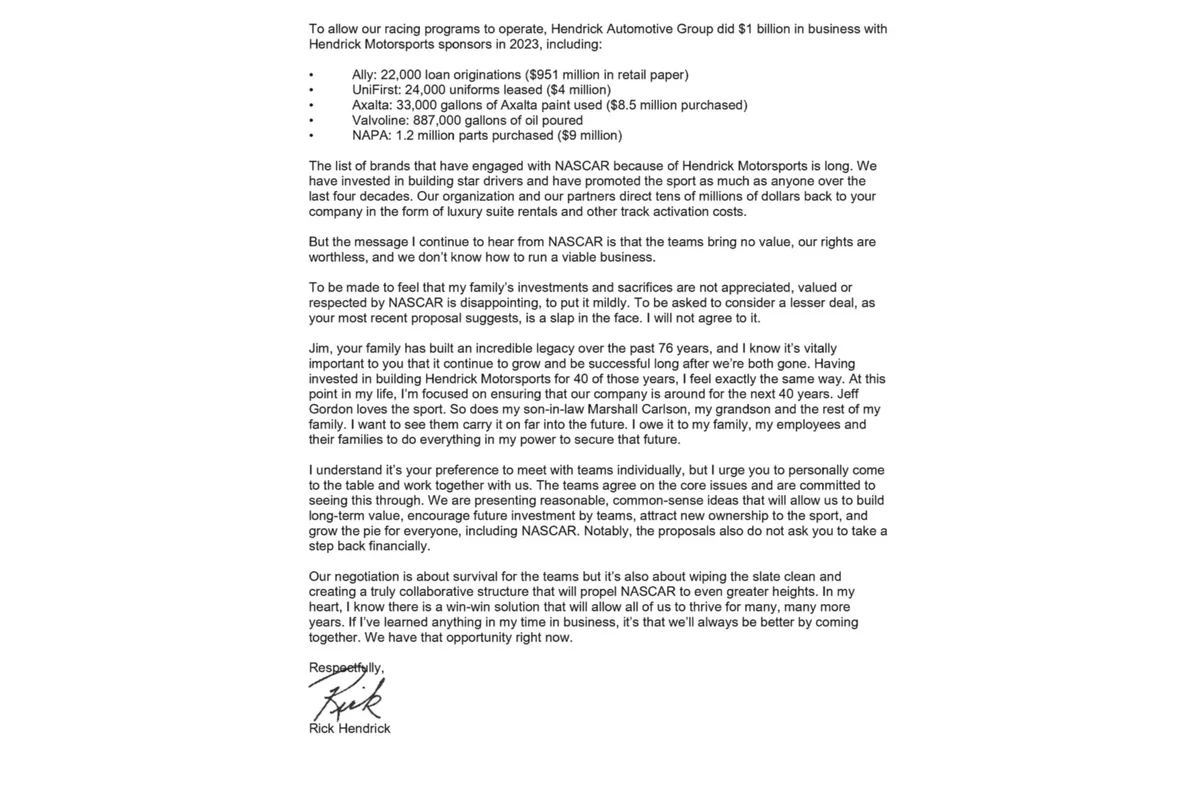
To illustrate the team’s wider economic influence, he detailed transactions between Hendrick Automotive Group and critical sponsors in 2023, noting:
“Ally: 22,000 loan originations ($951 million in retail paper)”
“UniFirst: 24,000 uniforms leased ($4 million)”
“Axalta: 33,000 gallons of Axalta paint used ($8.5 million purchased)”
“Valvoline: 887,000 gallons of oil poured”
“NAPA: 1.2 million parts purchased ($9 million)”
Additionally, Hendrick described the far-reaching impact his organization has had in attracting brands, building star drivers, and driving revenue back into NASCAR’s business through track activations and hospitality investments:
“The list of brands that have engaged with NASCAR because of Hendrick Motorsports is long. We have invested in building star drivers and have promoted the sport as much as anyone over the last four decades. Our organization and our partners direct tens of millions back to your company in the form of luxury suite rentals and other track activation costs,”
Rick Hendrick wrote.
Yet, despite these contributions, Hendrick expressed frustration at what he perceives as NASCAR’s lack of acknowledgment for the value teams bring to the table.
“But the message I continue to hear from NASCAR is that the teams bring no value, our rights are worthless and we don’t know how to run a viable business,”
he stated.
Seeking Respect and A Sustainable Future
Rick Hendrick’s letter also voiced a deeply personal disappointment in what he feels is disregard from NASCAR regarding ownership investment and risk. He wrote:
“To be made to feel that my family’s investments and sacrifices are not appreciated, valued or respected by NASCAR is disappointing. To put it mildly. To be asked to consider a lesser deal, as your most recent proposal suggests, is a slap in the face. I will not agree to it,”
Rick Hendrick asserted.
He referenced his multi-generational commitment to the sport, stating,
“Jim, your family has built an incredible legacy over the past 76 years, and I know it’s vitally important to you that it continue to grow and be successful long after we’re both gone. Having invested in building Hendrick Motorsports for 40 of those years, I feel exactly the same way. At this point in my life, I’m focused on ensuring that our company is around for the next 40 years. Jeff Gordon love the sport. So does my son-in-law Marshall Carlson, my grandson and the rest of my family. I want to see them carry it on far into the future. I owe it to my family, my employees and their families to do everything in my power to secure that future.”
Stressing the need for a collaborative solution, Hendrick wrote,
“I understand it’s your preference to meet with teams individually, but I urge you to personally come to the table and work together with us. The teams agree on the core issues and are committed to seeing this through. We are presenting reasonable, common-sense ideas that will allow us to build long-term value, encourage future investment by teams, attract new ownership to the sport, and grow the pie for everyone, including NASCAR. Notable, the proposals also do not ask you to take a step back financially.”
In closing, he underscored the existential nature of the current standoff:
“Our negotiation is about survival for the teams but it’s also about wiping the slate clear and creating a truly collaborative structure that will propel NASCAR to even greater heights. In my heart, I know there is a win-win solution that will allow all of us to thrive for many more years. If I’ve learned anything in my time in business, it’s that we’ll always be better by coming together. We have that opportunity right now,”
stated Rick Hendrick.
Broader Industry Implications and The Road Ahead
The antitrust trial, along with Rick Hendrick’s revelations, brings renewed focus to the debate over how NASCAR’s financial and organizational models affect the long-term health of the sport and its teams. Team owner Jeremy Mayfield’s criticisms and the ongoing push for a permanent charter system reflect industry-wide anxieties about fairness, stability, and profitability.
With negotiations at a standstill, the coming months may determine not only the financial future of high-profile organizations like Hendrick Motorsports but could also reshape how revenue, investments, and recognition are shared within NASCAR. Industry stakeholders and fans alike will be watching closely as the process unfolds, knowing that fundamental changes are likely necessary to ensure the longevity and vitality of stock car racing.