Dale Earnhardt Jr. shared his astonishment at NASCAR’s response to the Superstar Racing Experience (SRX) during a turbulent period marked by an antitrust lawsuit settlement involving 23XI Racing and Front Row Motorsports. His candid Dale Earnhardt Jr NASCAR reaction, aired alongside his sister Kelley Earnhardt-Miller, reveals confusion and skepticism over why NASCAR saw the smaller SRX series as a credible threat.
Unpacking NASCAR’s Strong Stance Against SRX
As the antitrust case unfolded, documents and testimony surfaced, showing that NASCAR top brass felt SRX was disruptive enough to warrant tightening their grip on racing venues with extended sanctioning contracts. Senior executives, including Steve O’Donnell, openly conveyed their frustration about SRX throughout both internal documents and live testimony during the trial.
Earnhardt Jr. addressed these revelations on the “Dale Jr. Download,” emphasizing his own surprise at the level of concern inside NASCAR’s leadership. The Superstar Racing Experience, created by Ray Evernham and envisioned as a throwback to IROC days, was intended to spotlight veteran drivers, distinctive personalities, and local talents through races in small markets. Despite recognizing the appeal, Earnhardt admitted he never engaged with the series.
“I gotta be honest, this shocked me,”
Earnhardt said on Tuesday’s Dale Jr. Download.
“I want to say that I’m a big fan, and I think I’m a good friend with Ray Evernham. When he started talking about SRX and what he wanted to do, in his mind, he wanted to re-create IROC. The initial idea of SRX as a series that would go into these local markets, and you would bring out these retired guys and some unique personalities, different forms of racing and offer up a car to the local hero. The original idea of SRX, in my mind, was a good idea. I will say, though, I wasn’t interested in it, personally. Out of the gate, I just didn’t have the bandwidth to get into it. I wasn’t a fan; I didn’t really watch too much of it. … No offense to anybody out there that was SRX fans or anybody that worked in the series… but I wasn’t into it.”
– Dale Earnhardt Jr., Driver and Broadcaster
He further questioned what he called an outsized reaction to SRX, painting the league as a minor player compared to NASCAR’s massive presence.
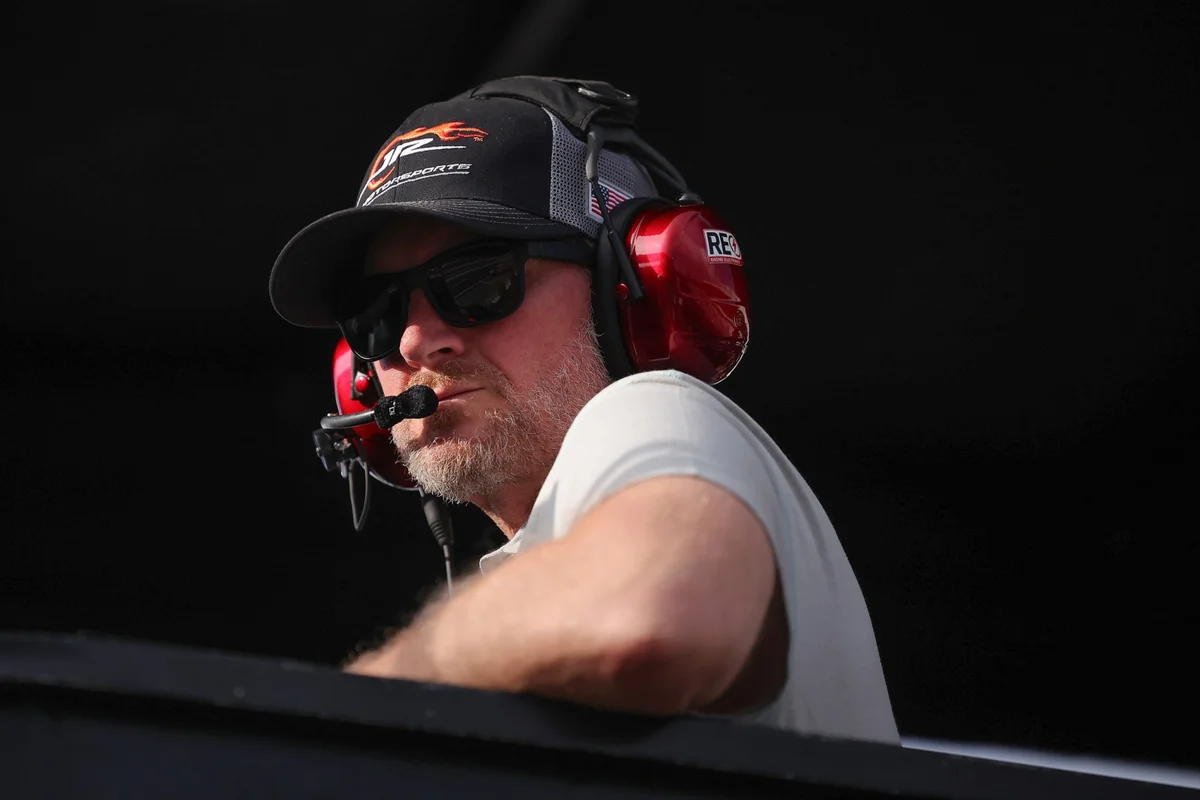
“To hear that they were even remotely the least bit threatened is so surprising to me because they’re this giant that’s NASCAR and SRX is just this little thing. They were like 12 cars just barely getting by financially. They’re tearing up so much shit, they had no idea they were gonna tear up so much shit. In the end, they couldn’t make the money work. SRX went away because it’s expensive to operate and the viewership numbers didn’t justify the TV contract and the TV contract couldn’t afford the series, so it just financially didn’t really work.”
– Dale Earnhardt Jr., Driver and Broadcaster
During the trial, NASCAR president Steve O’Donnell explained his concern that, as Cup Series drivers and sponsors participated in SRX’s summer events, there was risk of those mid-week short track races blurring the lines with NASCAR’s own product. Still, legal advisers eventually found no basis for action.
Earnhardt’s skepticism persisted regarding why NASCAR even treated SRX as a subject of controversy.
“I am surprised by the some of the comments I read from O’Donnell and a couple people of, ‘Man we gotta put an end to this or we gotta go take a look at this.’ Why are we worried? I don’t care [about the ratings], people were gonna be curious. … I’m not alarmed by that. … I was really surprised by that,”
Earnhardt said.
“I never saw, no disrespect, but I never would’ve worried or considered SRX a problem.”
– Dale Earnhardt Jr., Driver and Broadcaster
He argued a more constructive approach might have been to learn from SRX’s unique appeal and seek collaboration, especially as notable Cup drivers, including Denny Hamlin, Chase Elliott, and Ryan Blaney, participated in SRX’s family-oriented events.
“I would’ve looked at what they were doing… why do people like it and can we work together? It was interesting because it did morph. You had drivers like Denny, Chase, and Blaney, but Chase goes over there to race with his dad, have a little fun. Blaney with his dad. They were getting paid to go out there and do it for a little bit of money.”
– Dale Earnhardt Jr., Driver and Broadcaster
NASCAR’s Race Scheduling Tactics and Earnhardt’s Role
SRX’s perceived threat even led NASCAR leadership to discuss ways to pre-empt SRX from using iconic venues. Text messages among Steve O’Donnell, NASCAR president Steve Phelps, and Scott Prime, SVP of Strategy, revealed particular concern that SRX would beat NASCAR to hosting races at North Wilkesboro and Bowman Gray Stadium—especially if Earnhardt himself participated.
O’Donnell stated in a June 2022 conversation,
“Wait until (Dale) Jr. says he is running an event. Matter of time. They will go to North Wilkesboro with Jr. if we are not careful. We need to be the first back.”
Prime and O’Donnell went back and forth strategizing on scheduling All-Star events at Wilkesboro and Bowman Gray, trying to ensure NASCAR reclaimed those historic dates.
As a result, both North Wilkesboro and Bowman Gray eventually made their way onto the Cup Series schedule in 2023 and 2025, respectively. Earnhardt, however, credited key figures and North Carolina’s public investment, rather than NASCAR’s internal push, for the revival of racing at these venues.
“Listen, there is a lot of stuff about NASCAR in all of this that I don’t know,”
Earnhardt said.
“I don’t know everything about how they run things, and I certainly didn’t know how they felt about some things, and how these text messages have unveiled some things. But I’ll tell you what I do know, is that North Wilkesboro came back because of Marcus Smith … NASCAR, you know, they didn’t play any role. Now, they have to go, when Marcus comes up and says, ‘Man, I’ve got this track back together, I want to put it on the schedule.’ They’ve gotta go, ‘Okay, good.’”
– Dale Earnhardt Jr., Driver and Broadcaster
He singled out Speedway Motorsports CEO Marcus Smith and local government initiatives, including the Build Back Better fund, as vital to restoring Wilkesboro to the schedule—pointing out that NASCAR’s efforts came only after others had done the groundwork.
“But, look, NASCAR never was going, ‘Guys, we gotta get Wilkesboro going.’ This isn’t a knock to them, you know, this isn’t a knock to them, they shouldn’t take this as an insult, but Wilkesboro is back because of everybody else. The government, our local government, and the town, a lot of volunteers. Fucking, 20 years of volunteers, people just like even keeping the grass mowed for 20 years. All of those reasons, the fact that they kept the track in somewhat reasonable shape, to even be considered to be brought back. Those people should be commended. You know, we can go on about this.”
– Dale Earnhardt Jr., Driver and Broadcaster
Kelley Earnhardt-Miller highlighted that Dale’s involvement in the CARS Tour and his appearance at a pre-NASCAR event at Wilkesboro drew massive attention, suggesting that his celebrity was a key element in making the “Race Track Revival” a success.
The Wider Implications for NASCAR and Future Events
The conflict revealed during the trial underscored both a protective and reactive side of NASCAR’s leadership faced with outside ventures like SRX. Despite the initial adversarial posture, SRX’s financial struggles and inability to secure a sustainable television deal led to its decline without intervention from NASCAR’s legal team. Meanwhile, efforts to secure classic venues for the Cup Series have revitalized interest in historic tracks, favoring an atmosphere where collaboration and heritage play significant roles.
Voices like Earnhardt and his sister Kelley bring a perspective that values innovation, local passion, and the contributions of volunteers, over corporate maneuvering. These developments set a precedent for how the sport may handle outside competition and grassroots movements in the future, keeping fan appeal and authenticity at the center of the conversation.