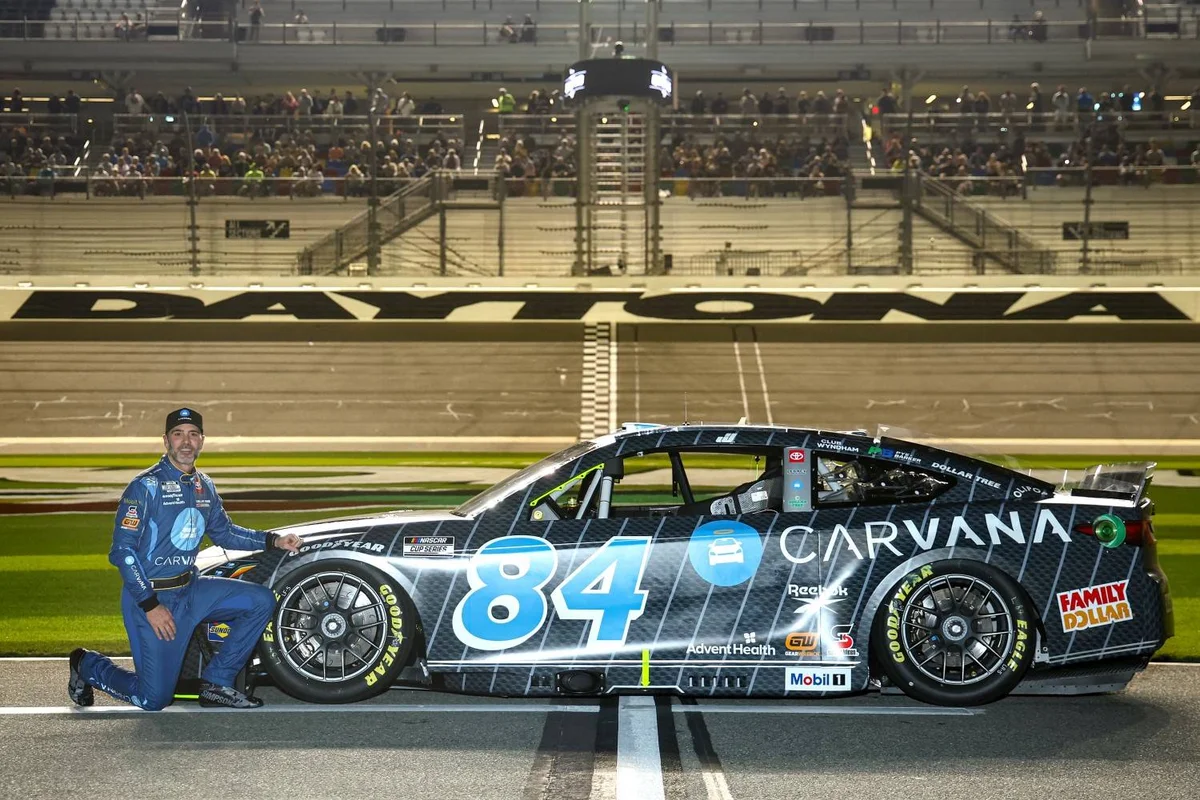
Jimmie Johnson’s Daytona 500 return in 2026 has reignited discussions and controversy surrounding NASCAR’s entry rules, especially after an announced rule change led to confusion and frustration among fans. Confirmed to drive the Carvana No. 84 for Legacy Motor Club, Johnson’s entry through the Open Exemption Provisional has sparked debate over fairness, tradition, and the integrity of the sport’s biggest event.
Rule Change Overshadows Jimmie Johnson’s Comeback
When Jimmie Johnson posted a teaser of his Carvana No. 84 paint scheme, it confirmed what many NASCAR fans had hoped for—his highly anticipated return to the Daytona 500 in 2026. As a seven-time Cup Series champion, Johnson’s involvement would typically be met with unanimous celebration. Yet this year, a new entry rule, confusion over the field size, and the issue of purse eligibility have placed Johnson at the center of a debate that is testing the patience of the sport’s audience.
The source of the uproar traces back to a public conversation on social media, where a fan directly questioned how Johnson’s provisional entry would affect the starting field:
“If the rule is the same as last year, the field will only be 41 if he NEEDS the provisional. If he qualifies, the field will be 40. Right?”
— fan
Bob Pockrass, a notable reporter for NASCAR, addressed this confusion, stating,
“No. The rule changed after the Daytona 500 last year, so the driver now has to commit to using the provisional and getting no points/no purse money,”
highlighting a revision that few fully understood before Johnson’s announcement.
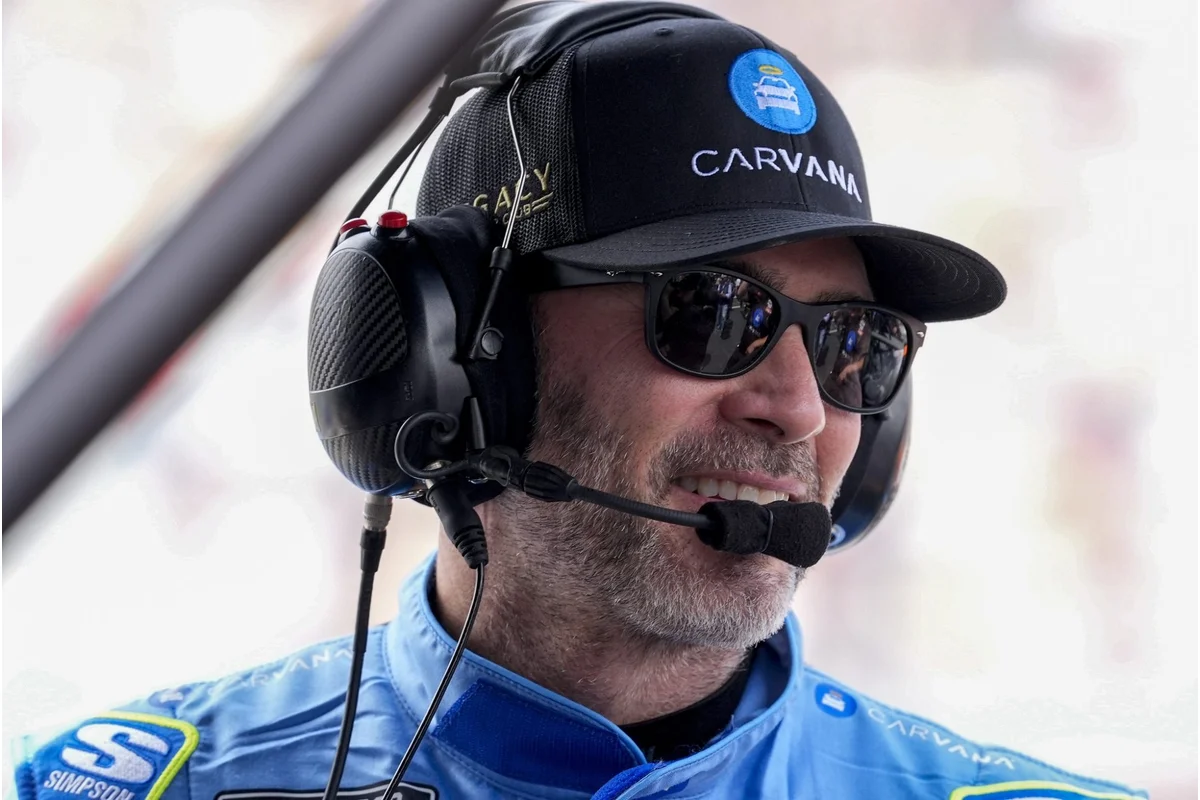
With Legacy Motor Club, which Johnson co-owns, successfully applying for the Open Exemption Provisional (OEP), the No. 84 Toyota is guaranteed a spot on the starting grid. This means the 2026 Daytona 500 will feature 41 cars, with Johnson’s starting position determined by the Duel race result. However, because Johnson’s entry is through the provisional, he cannot claim championship points or a share of the race’s purse, although he remains eligible to race for victory and the iconic Harley J. Earl Trophy.
The Origins and Purpose of the Open Exemption Provisional
The Open Exemption Provisional was announced before the 2025 NASCAR season to serve as a “promoter’s choice” for high-profile drivers—especially accomplished stars from outside the regular NASCAR field—offering them an automatic start in showcase races like the Daytona 500. This was designed to increase the event’s visibility with appearances from world-class talents. Trackhouse Racing was the first team to utilize the OEP, securing four-time Indianapolis 500 winner Hélio Castroneves a debut NASCAR Cup Series start at Daytona in 2025.
Clarifying the 2026 scenario, Bob Pockrass summarized for fans:
“Jimmie Johnson has guaranteed spot in Daytona 500. Legacy applied for and has been granted the ‘open exemption provisional’ … so Johnson is guaranteed spot and field will be 41 cars. Johnson won’t get purse $. Where he starts I’d expect depends on finish in duels. @NASCARONFOX”
— Bob Pockrass (@bobpockrass) January 7, 2026
— Bob Pockrass (@bobpockrass) January 7, 2026
The key detail lies in NASCAR’s 2025 rule update:
“The Open Exemption Provisional will be applied only if more than 40 vehicles are qualifying for the Event. In that case, it will be applied regardless of the vehicle’s Qualifying position, and the starting field will be 41.”
Previously, an OEP driver qualifying on speed did not expand the field. Now, regardless of how well Johnson runs in qualifying or his Duel, once the OEP is granted, the race expands to 41 cars with the provisional driver always ineligible for points or purse.
Fans Vent Over Complicated Entry Rules and Lost Tradition
The technical tweaks and their impact did not go unnoticed. After Pockrass explained how the Open Exemption Provisional changed the rules and field size, fan confusion and frustration grew. One fan put it directly:
“Did they change the rule? I thought if he raced/qualified his way in then it’s only 40 cars still?”
This was quickly confirmed as incorrect, as officials made it clear at the start of last year that the 41-car field is locked in whenever the OEP is used, even if the driver could have qualified by speed.
Some long-time fans questioned why NASCAR restricts itself to 41 entries at all, given that past “pre-charter era” field sizes could stretch to 43:
“Why can’t we do 43 like it been for many years and Daytona is perfect place for it,”
a fan wrote, reflecting on a time viewed as more inclusive and less limited by bureaucratic hurdles.
But perhaps the most emotional backlash surrounded the issue of money and rewards. Another fan asked,
“So he would still be treated as the 41st driver and get no money even if he races his way in?”
For Johnson and other OEP drivers, the answer remains the same: eligibility for the win and trophy, but neither points nor a place in the race’s payout, regardless of performance.
This detail has driven discontent among even Johnson’s supporters, with remarks such as:
“I’m a Jimmie Johnson fan and I think this rule is so stupid. Race your way in or don’t race at all,”
underscoring how split the audience has become. Others expressed frustration at the convoluted rulebook, with one fan simply stating, “Just stop…”
Johnson’s Return: Aiming for History Amid Controversy
Despite the turbulence, Jimmie Johnson’s own approach to the Daytona 500 drama has remained straightforward. After retiring from full-time competition in 2020 and returning with a limited 2023 schedule, Johnson has consistently accepted the outcomes required for part-time drivers through the OEP. His recent results include an impressive third-place finish at Daytona in 2025, marked improvement over previous years and a sign of his enduring skills. With past Daytona 500 victories in 2006 and 2013, Johnson enters 2026 looking for a symbolic 84th Cup win, fittingly while running the No. 84 car for Legacy Motor Club.
For his supporters, it is clear Johnson is not leveraging the system for personal advantage, but competing within the boundaries set by NASCAR. Yet, the emotional divide over NASCAR’s evolving rules and traditions speaks to a broader concern about the balance between marquee participation and a fair, competitive process for all drivers.
The Debate Ahead: Balancing Star Power and Tradition in NASCAR
The backlash triggered by Johnson’s guaranteed entry is not simply about one legendary driver; it is rooted in questions of transparency, sport tradition, and the meaning of earning a Daytona 500 spot. NASCAR’s aim to bring in high-profile competitors via the Open Exemption Provisional demonstrates a push for spectacle, but it risks alienating fans who value merit-based qualification and straightforward competition.
As the 2026 Daytona 500 draws nearer, the sport may see continued debate between competition officials, drivers, and its passionate audience over the intent and impact of such rule changes. For now, Jimmie Johnson’s Daytona 500 return stands at the crossroads of celebration and controversy, serving as a focal point for NASCAR’s ongoing effort to balance star attraction with the purity of its historic event traditions.
Jimmie Johnson has guaranteed spot in Daytona 500. Legacy applied for and has been granted the "open exemption provisional" … so Johnson is guaranteed spot and field will be 41 cars. Johnson won't get purse $. Where he starts I'd expect depends on finish in duels. @NASCARONFOX
— Bob Pockrass (@bobpockrass) January 7, 2026