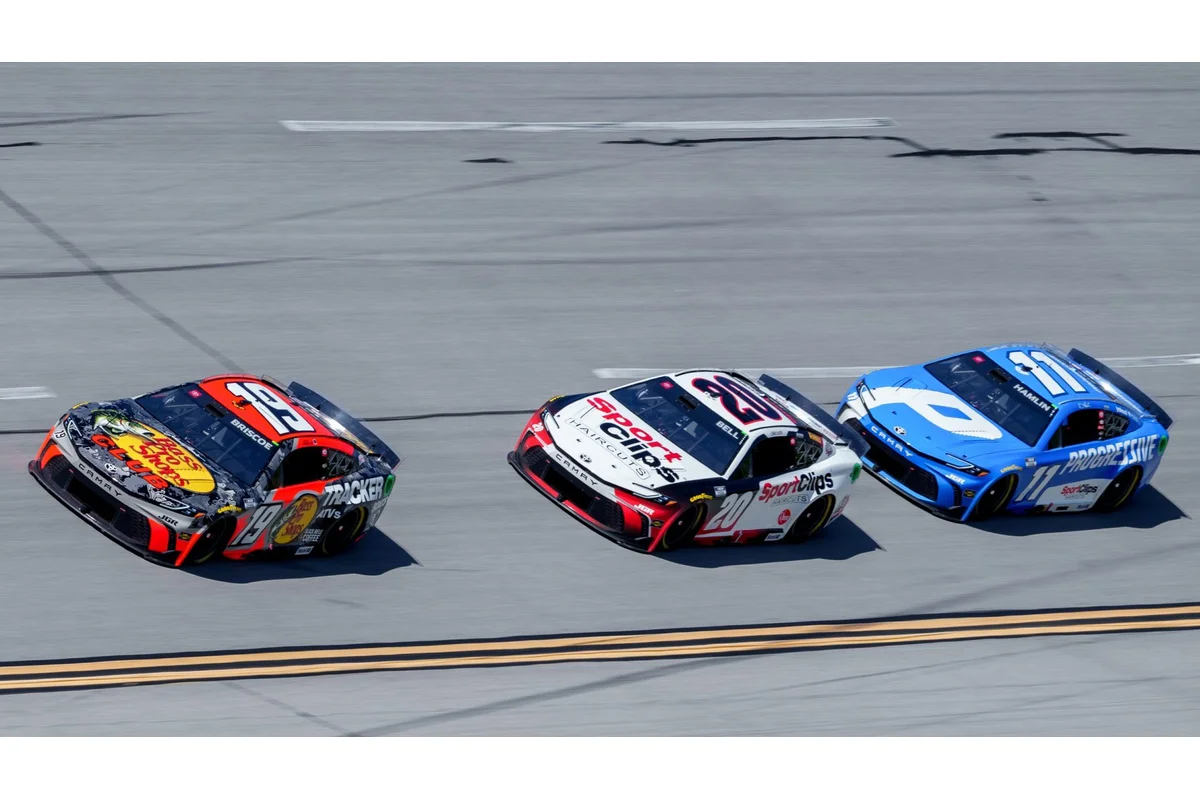
Christopher Bell, recognized as one of Joe Gibbs Racing’s top talents, has lifted the lid on overlooked dangers tied to NASCAR simulator training, offering candid insights that could affect how fellow drivers approach their prep. His comments, delivered via the team’s YouTube platform, clarify the gap between virtual and real-world racing, with implications for the way drivers use simulator technology in their pursuit of excellence.
Behind-the-Scenes Work Drives Bell’s Performance
Christopher Bell’s career trajectory in the NASCAR garage has been marked by steady improvement, earning him a reputation as a fast-rising leader for Toyota, particularly as Denny Hamlin’s expected retirement draws closer. Central to Bell’s development is his willingness to put in effort away from the spotlight, pushing boundaries in simulator sessions to refine his craft for on-track competitions. This hard work is frequently cited as a key reason for his advancing results and standings among elite stock car drivers.
The Double-Edged Sword of Simulators
Bell recently highlighted the critical role simulators play in modern motorsports, emphasizing both their unique benefits and the hidden drawbacks. While the safe environment allows racers to extend their limits without risking actual crashes, it also introduces a subtle risk—drivers may develop habits unfit for high-stakes, real-life scenarios.
So, one thing that the drivers love to talk about is the fear factor. So, you come in here, and oftentimes you can run faster laps in the simulator than you can in real life just because you’re not going to wreck the car.
Christopher Bell said via JGR YouTube channel.
Bell’s remarks spotlight a common sentiment: with no real consequences in the sim, drivers routinely achieve times that might be impossible or unsafe in genuine race conditions. The loss of the “fear factor” in a simulated setting makes it tempting for racers to attempt maneuvers they would never risk at an actual track.
Testing Limits in High-Risk Scenarios
The temptation to push harder in the simulator environment is particularly strong during simulated sessions on perilous circuits like the Chicago Street Course—a track notorious for its unforgiving walls and narrow racing lanes. Bell notes that in such virtual scenarios, drivers often court danger far beyond their real-world thresholds, knowing that any mistake can simply be erased with a reset.
If you do wreck, you tell him he’s going to hit the reset button, and so you’re willing to push it a little bit harder than you would in real life…Specifically, like the road courses, [the] Chicago Street Course is the one that comes to mind. It’s a super super tight track with walls on both sides. There’s no room for error.
Christopher Bell added.
This freedom in the simulator can breed risky habits, especially in tight, technical corners where drivers learn to rely on the lack of real-world consequences. Bell, reflecting on his time piloting the No.20 Toyota Camry for Joe Gibbs Racing, warns that repeated exposure to “safe” crashes in the sim may alter a driver’s judgment during actual competitions.
The Challenge of Translating Sim Skills to Reality
Bell further explained that the strategies developed in simulator practice may not carry over successfully into real events. When faced with identical scenarios on the genuine track, most drivers tend to reconsider, often backing out of risky moves they comfortably attempted on the sim. The lack of consequence in simulation struggles against the caution required when real cars and championship points are at stake.
And you go in the simulator, and you’re just like, ‘Oh, I’m gonna hammer out a lap, and if I hit the wall, no big deal.’ And then you go to real life, and you have to like back it up a little bit. So, yeah, you have to make sure that you, as the driver, drive it realistically.
Christopher Bell asserted.
He cautions his fellow racers to maintain disciplined, realistic approaches even during virtual training, or risk letting overconfidence and poor habits slip into actual race days. This insight deepens the ongoing discussion about simulator practices’ role in shaping the future of NASCAR driver development.
Comparing Iconic Racing Events: Daytona 500 Versus Chili Bowl
Beyond simulator nuances, Bell has shared perspectives from his experience as a standout in both stock car and dirt track racing. With an impressive track record, including three consecutive Chili Bowl victories, he regularly finds himself addressing the ongoing debate over which event holds more prestige—the legendary Daytona 500 or the diversity-rich Chili Bowl Nationals.
The Daytona 500 is the biggest race of the NASCAR schedule. But it’s only the NASCAR guys. Whereas anybody can enter the Chili Bowl. So, it’s kind of a barometer for drivers where everybody is there. You get a lot of top drivers from different disciplines and people who don’t compete against each other all the time. It’s a great show.
Christopher Bell said.
Bell acknowledges the Daytona 500’s unrivaled status within the NASCAR calendar but values the inclusivity and cross-discipline competition at the Chili Bowl, where competitors from diverse racing backgrounds test themselves on an even playing field. According to Bell, the gathering of top-tier talent and the challenging nature of the dirt event make the Chili Bowl an essential barometer for racing excellence, even if it doesn’t quite match the Daytona 500’s storied history.
Why Bell’s Insights Matter for NASCAR’s Future
With NASCAR increasingly reliant on technology for training and strategic development, Bell’s honest assessment of simulators stands as a significant caution for the next generation of drivers. His call for a more measured, reality-grounded approach could influence training philosophies at Joe Gibbs Racing and across other teams, as the balance between tech advancement and on-track sensibility grows more delicate.
For aspiring drivers and seasoned professionals alike, Christopher Bell’s NASCAR simulator insights offer valuable lessons in vigilance and discipline, providing a reminder that while technology can accelerate growth, it cannot yet replace the careful risk management and judgement honed on real tracks. As Bell continues his ascent in the sport and possibly takes up the leadership mantle for Toyota after Hamlin, his experiences and warnings could shape how teams and drivers prepare for elite competitions in both the stock car arena and dirt racing spectacles alike.