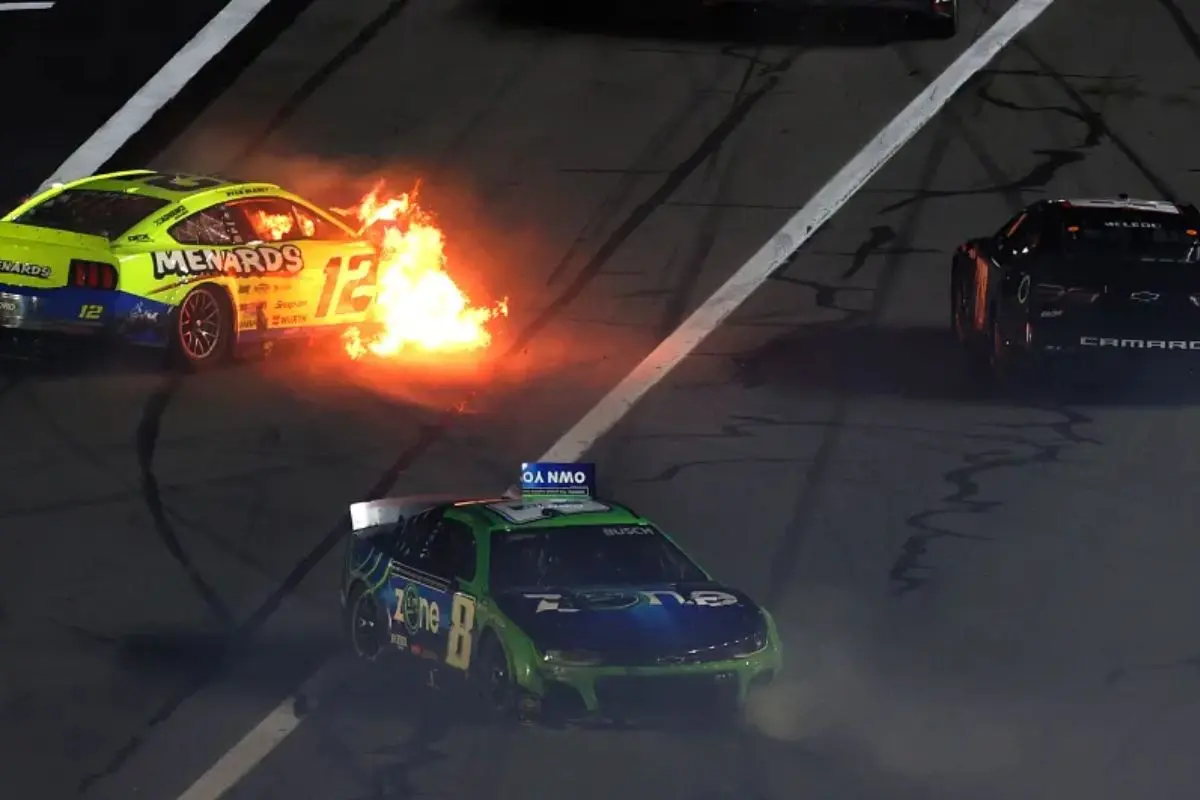
When NASCAR Race Cars Caught on Fire: The roar of engines and the thrill of speed are synonymous with NASCAR, yet beneath the excitement lies a persistent peril—fire. While NASCAR has historically been proactive in enhancing driver safety, these fiery reminders suggest a gap that demands attention. How will NASCAR balance the electrifying allure of racing with the imperative of safety?
Key Highlights
- Ryan Newman’s 2003 crash showed the importance of fire-resistant suits and onboard extinguishing systems in NASCAR safety.
- Kevin Harvick’s 2022 incident highlighted concerns over Next Gen car safety and NASCAR’s response to driver safety issues.
- Daniel Suarez’s 2024 pit road fire emphasized the critical role of precision and quick response in pit crew operations.
- NASCAR continuously evolves safety regulations and technology to address fire hazards and improve driver and crew protection.
- Regular fire scenario training for drivers and pit crews enhances response times and reinforces NASCAR’s commitment to safety.
NASCAR’s Ongoing Battle Against Fire Hazards
In NASCAR, the specter of fire hazards remains an ever-present threat, challenging the sport’s commitment to safety. Despite the adrenaline-fueled excitement that draws fans to the racetrack, the reality of fiery incidents looms large, serving as a striking reminder of the inherent dangers involved.
While crashes can be spectacularly chaotic, fires within the confines of a race car present a particularly harrowing ordeal for drivers and their crews.
NASCAR has made notable strides in enhancing safety, implementing measures such as fire-retardant suits, certified helmets, and intumescent coatings. These advancements, alongside the introduction of right-side backstop panels in the Next Gen cars, emphasize the sport’s proactive approach to mitigating fire risks.
Yet, the flames that sometimes engulf these high-speed machines still stir unease, raising questions about the sufficiency of existing safety protocols.
For fans, the visceral image of a car ablaze is both terrifying and mesmerizing, an indication of the sport’s raw intensity. The thrill of speed is inextricably linked to the potential for disaster, a dynamic that NASCAR continues to navigate with vigilance and innovation.
NASCAR’s commitment to safety remains steadfast, yet the conversation around fire hazards continues to evolve. Fans and officials similarly understand that while progress has been made, the pursuit of safety is a relentless odyssey—one that requires constant adaptation and vigilance in the face of ever-present danger.

Ryan Newman’s Fiery Crash at Michigan in 2003
Amidst NASCAR’s ongoing efforts to improve safety against the ever-looming threat of fire, Ryan Newman’s fiery crash at Michigan International Speedway in 2003 stands as a vivid reminder of the challenges the sport faces.
During the Sirius 400, on lap 36, Newman’s #12 Penske Racing Dodge experienced a catastrophic tire failure, sending him into a spin that culminated in flames erupting from the rear of his car. The incident highlighted the inherent dangers of high-speed racing and the unpredictable nature of mechanical failures.
Despite the intensity of the fire, Newman emerged from the wreck unscathed—a demonstration of the efficacy of NASCAR’s stringent safety protocols. His swift evacuation from the inferno was facilitated by the fire-resistant suit he wore, an essential element of personal protective gear mandated by the league.

Furthermore, onboard fire extinguishing systems played a significant role in containing the blaze, preventing what could have been a more dire outcome.
For fans and safety experts similarly, the crash was a striking example of both progress and the perpetual need for vigilance in motorsport. It highlighted the delicate balance between pushing technological boundaries and ensuring that safety measures evolve in tandem.
Newman’s harrowing experience served as a catalyst, prompting further advancements in safety technology and procedures.
Kevin Harvick’s Scare at Darlington in 2022
During the 2022 Cook Out Southern 500 at Darlington Raceway, the racing world held its breath as Kevin Harvick, a seasoned driver and 2014 Cup champion, faced a harrowing ordeal on the track.
Running competitively in the top five during the race’s final stage, his #4 Ford Mustang unexpectedly erupted in flames from the front wheels. Harvick’s quick reflexes were on display as he leaped out of the fiery vehicle, a reminder of the ever-present dangers in auto racing.
The incident was later attributed to rubber buildup igniting under high heat conditions—a perilous consequence of the grueling race environment. Harvick did not mince words post-race, directing sharp criticism at NASCAR, expressing frustration over what he perceived as the organization’s sluggish response to safety concerns with the Next Gen car.

Harvick’s scare at Darlington served as a poignant reminder of the relentless pursuit for safety in motorsports—a pursuit that requires constant vigilance and adaptation to technological advances.
Daniel Suarez’s Pit Road Fire at Daytona in 2024
As sparks flew on the pit road at the 2024 Coke Zero Sugar 400, Daniel Suarez’s #99 car became the epicenter of a fiery spectacle that highlighted the unpredictable nature of NASCAR racing. The incident unfolded on Lap 37 during the initial pit stop, as the #99 exited its stall. A minor fuel spill, inadvertently left by Suarez’s crew, met with a spark from a backfire on Denny Hamlin’s #11, which was stationed behind Suarez. The result was a sudden blaze that engulfed the rear bumper of Suarez’s car, instantly drawing gasps from the crowd and attention to the inherent risks of high-speed motorsport.
For fans and experts similarly, the incident was a vivid reminder of the razor-thin margin for error in NASCAR. The precision of a pit crew is paramount, and even a minor lapse can escalate into a dramatic event.
Suarez, known for his resilience and composure, managed to navigate the situation with aplomb, swiftly driving the flaming car out of harm’s way. His quick thinking and the rapid response from the safety crew guaranteed the fire was extinguished without further incident.
Fires as a Constant Reminder of NASCAR Safety Challenges
The fiery incidents on the race track, while dramatic and enthralling, highlight a relentless truth about NASCAR: safety remains an ongoing challenge despite the sophisticated measures in place.
These incidents serve as clear reminders of the ever-present risks inherent in motorsport. Even with cutting-edge technology and rigorous safety protocols, the unpredictability of high-speed racing can never be entirely tamed.
Fires on the track are not just visually arresting; they are a clarion call for continuous advancements in driver protection.
For NASCAR enthusiasts and engineers similarly, these fiery episodes emphasize three vital points:
- Technological Evolution is Essential: Each fire incident highlights the necessity for ongoing innovation in safety equipment. Improved fire-resistant materials and advanced extinguishing systems are central in minimizing risk.
- Human Element Cannot Be Overlooked: Despite technological advancements, the role of the driver and pit crew in preventing and responding to fires is essential. Training programs and simulations should constantly evolve to prepare them for these high-stakes scenarios.
- Safety Regulations Must Adapt: As racing technology evolves, so too must the safety regulations. Governing bodies should remain agile, ensuring rules and guidelines are reflective of the latest advancements and lessons learned from past incidents.
For fans, the thrill of NASCAR lies not just in speed and competition, but in witnessing a sport that pushes the boundaries of human and machine.
Yet, with each fiery spectacle, the need for vigilance and innovation is reaffirmed. The balance between spectacle and safety remains a primary concern, ensuring that the adrenaline rush of the race is matched by a steadfast commitment to driver and crew safety.

News in Brief: When NASCAR Race Cars Caught on Fire
The persistent threat of fire in NASCAR emphasizes the ongoing challenges in ensuring driver safety despite advancements in technology and safety protocols. Incidents such as Ryan Newman’s crash, Kevin Harvick’s scare, and Daniel Suarez’s pit road fire highlight the critical need for continuous evaluation and improvement of safety measures.
These events serve as reminders of the sport’s inherent risks and the importance of maintaining a balance between thrilling competition and uncompromising safety standards.
ALSO READ: NASCAR’s New Generation of Drivers Poised to Challenge the Veterans in 2025