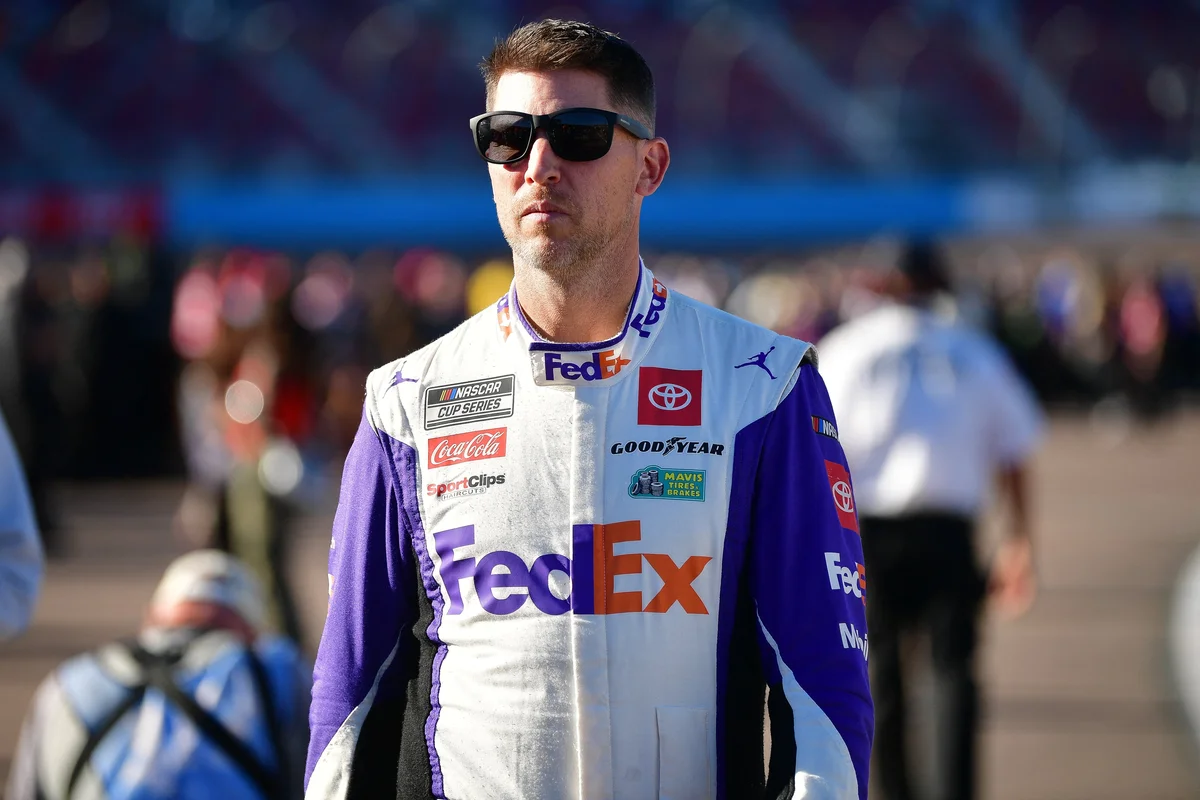
The Denny Hamlin NASCAR antitrust trial intensified Tuesday, as front office figures and legal teams clashed in a courtroom packed with stakeholders and sharp warnings from Judge Louis B. Bell. The latest day of proceedings was marked by heated testimony, deepening rifts, and the emergence of new internal documents linking several key figures in the sport.
Courtroom Tensions Escalate with Testimony from Front Row Motorsports Owner
As the trial resumed, Bob Jenkins, owner of Front Row Motorsports, completed a tense round of testimony dominated by debate over his team’s financials and the Cup Series’ economic landscape. NASCAR attorney Lawrence Buterman pushed Jenkins to explain discrepancies in reported investment amounts for Cup entries, juxtaposing Jenkins’ claim that a competitive entry requires approximately $20 million per car against records showing no more than $14.5 million in damages for the period in question.
Jenkins held firm on his aggregate estimate, asserting that this figure was drawn from data shared by multiple teams, with a financial expert expected to elaborate later in the proceedings. When Buterman spotlighted over $1 million in damages attributed to Truck Series losses within FRM’s Cup claim, Jenkins admitted that these losses did not belong as part of the Cup’s damages.
Pressed on his continued purchase of valuable Cup charters despite alleging the framework was inequitable, Jenkins explained candidly,
“based on the belief that some day, they will be fair.”
Jenkins, Owner, Front Row Motorsports.
Charters, Text Messages, and Denny Hamlin’s Role in the Dispute
The topic shifted as Buterman referenced private text exchanges between Jenkins and Denny Hamlin, the co-owner of 23XI Racing. In arguments comparing Jenkins’ use of deadlines in a failed merger attempt with Hamlin to NASCAR’s own charter policy timelines, Jenkins dismissed efforts at equivalency, saying he was not operating as a monopoly and noting Hamlin had alternatives such as turning to teams like StarCom or Rick Ware Racing.
An added layer of tension arose when Jenkins was challenged about a message suggesting Rick Ware could “charge whatever” for a charter offered to Hamlin. Jenkins denied any manipulation of RWR’s pricing and maintained he never shared confidential financials. The potential merger between FRM and 23XI ultimately collapsed, Jenkins said, due to Toyota’s inability to support both engine programs and urgent demands from Ford and Roush for clarity about his team’s direction.
NASCAR President Steve O’Donnell Faces Scrutiny Over League Structure
In a shift of focus, NASCAR president Steve O’Donnell took the witness stand for an extended, high-stakes interrogation led by plaintiffs’ attorney Jeffrey Kessler. Kessler drew extensively from O’Donnell’s handwritten notes, internal discussions, and correspondence, dissecting topics that ranged from so-called “Gold Codes”—which Kessler labeled a “nuclear option”—to behind-the-scenes dialogues about breakaway series and internal league tensions.
Kessler pressed O’Donnell on whether NASCAR leadership was preparing for the formation of a potential rival racing series. O’Donnell acknowledged that he considered such scenarios, specifically involving Speedway Motorsports, Eldora, and the Indianapolis Motor Speedway, underlining that contingency planning is a core part of his executive role.
Much debate centered on NASCAR’s recent strategy of embedding exclusivity clauses in Xfinity and Truck Series sanctioning deals, which Kessler argued effectively preclude new series from accessing most major venues. O’Donnell insisted teams unwilling to enter into the charter agreements could still attempt to participate as open entries, but Kessler countered that the option was not plausible. O’Donnell replied, I’m not sure about that.
Leadership Discord and an Uncertain Path Forward
Internal friction among NASCAR’s top decision makers surfaced when Kessler presented meeting notes showing legendary driver Jeff Gordon questioning whether the France family
“was open to a new model”
for 2025. Ben Kennedy initially responded affirmatively, but O’Donnell later testified that Jim France ultimately did not back this revised model.
Tensions further mounted after Kessler cited a message in which O’Donnell characterized Kennedy’s negotiation posture as a
“
comfortable 1996, fuck the teams, dictatorship…tiny sport,
”
O’Donnell.
Confronted about this statement, O’Donnell paused at length before suggesting the “dictator” reference could have applied to anyone in the room. Such moments highlighted the rift among NASCAR’s leadership ranks, with insider perspectives and external communications becoming flashpoints in the larger antitrust debate.
Worries of Competition: The SRX Series Episode and Broadcast Negotiations
A significant focal point of the plaintiffs’ argument involved NASCAR’s response to the rise of the Superstar Racing Experience (SRX), especially as some active Cup drivers—including those from Stewart-Haas Racing (SHR)—participated. O’Donnell recounted his initial expectation that Tony Stewart’s involvement would not resemble the NASCAR product, based on assurances from SHR president Brett Frood, yet acknowledged,
“
all things that ended up happening.
”
O’Donnell.
O’Donnell said his concerns grew as SRX drew more big names and attracted a format more closely matched to NASCAR, stating SRX looked increasingly “like NASCAR.” Kessler underscored NASCAR’s refusal to allow Speedway Motorsports a contract exception to host SRX events, accusing NASCAR of using its agreements to block new competitors. O’Donnell defended the decision as being tied to negotiations for TV revenue, testifying,
“
we wanted to gain as much TV revenue for the teams and tracks as possible.
”
O’Donnell.
Kessler’s cross-examination delved into O’Donnell’s legal inquiry about Denny Hamlin’s prospective participation in SRX. When questioned whether his aim was primarily to halt SRX’s development, O’Donnell maintained,
“
I just wanted legal to look at it.
”
O’Donnell.
NASCAR Finances, Governance, and High-Stakes Investments Revealed
During the intensive questioning, O’Donnell detailed his own compensation arrangements, listing a $1.2 million annual salary plus bonuses, and revealed significant financial losses for the league—$6 million on a Mexico City race and $55 million over three years with the Chicago Street Course project.
Despite such losses, he emphasized the strategic importance of the Chicago Street Race, noting its role in securing new broadcast and streaming partners:
“
was able to get $1 billion because we had the Chicago Street Race and Mexico City,
”
O’Donnell, and asserting that key partners such as Amazon would not have joined without the Chicago event.
A further flashpoint included the discussion of NASCAR’s decision to abandon the longstanding “three strikes” rule, which allowed teams to veto organizational decisions. O’Donnell asserted that holding on to this rule would have blocked expansion initiatives, adding,
“
we wouldn’t have gone to the Chicago Street Race or Mexico City
”
O’Donnell.
Judicial Frustration and Pressures for a Speedier Resolution
The slow progress of the proceedings clearly tried Judge Bell’s patience. Addressing both legal teams, Bell warned that the trial was veering into exhaustive detail:
“
a whole lot of trees and not a lot of forest,
”
Judge Louis B. Bell, Judge.
He criticized the repetitive nature of exhibits and questioning, emphasizing the need to keep jurors engaged with the main issues. While the plaintiffs initially planned to finish their presentation by Wednesday, Kessler admitted he couldn’t conclude before the following Tuesday—an estimate Judge Bell flatly rejected. Both parties have since trimmed their witness lists to align with the court’s deadlines, with particular attention paid to ensuring Roger Penske can testify during his available window.
Trial Moves Forward Amid Growing Pressure and Uncertainty
Concluding a day of emotional turbulence and frequent clashes, O’Donnell’s direct examination gave way to NASCAR counsel Christopher Yates. Despite hours of testimony, the sense of mounting urgency was unmistakable, as Judge Bell’s pointed comments made clear the pace must accelerate.
As the Denny Hamlin NASCAR antitrust trial moves forward, key figures such as Ben Kennedy, Jeff Gordon, Jim France, and Bob Jenkins have all assumed central roles in shaping the story. The outcome of the proceedings will have a profound impact on the commercial structure of the sport, the relationship between teams and NASCAR leadership, and the broader competitive landscape of American motorsports.