
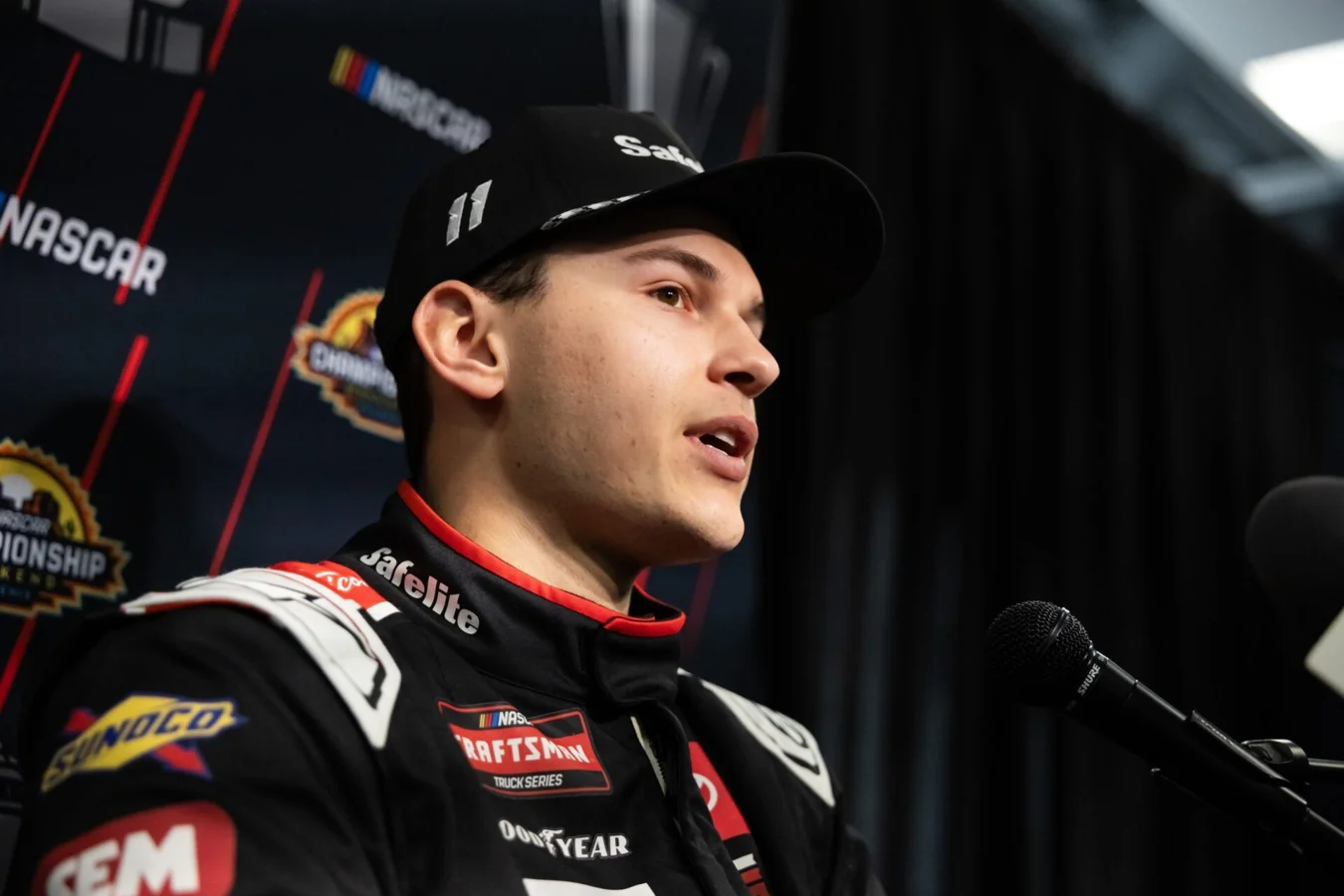
The Ty Gibbs Corey Heim feud has ignited major controversy in NASCAR, leading to a significant split within toyota/”>Toyota’s racing program as generational talent Corey Heim faces an uncertain future following a record-breaking season. Despite Heim’s domination in the Truck Series, tensions with Ty Gibbs have disrupted the typical advancement pipeline, leaving both fans and experts questioning the manufacturer’s decisions and long-term strategy.
Corey Heim’s Dominance Sets New Standards in NASCAR’s Truck Series
In the 2025 NASCAR Truck Series season, Corey Heim, racing the No. 11 for Tricon Garage, delivered a performance that redefined the meaning of dominance. Heim not only won 12 of the 23 races – surpassing Greg Biffle’s historic 1999 tally of 9 victories – but also led a staggering 1,625 laps, breaking Mike Skinner’s 1996 record. The young driver claimed 19 top-five finishes and posted an average result of 1.4 across the seven playoff events, culminating in clinching the Truck Series championship for the year.
This extraordinary string of achievements follows Heim’s prior regular season titles from 2023 and 2025; he also demonstrated promise in select starts in both the Xfinity and Cup Series, including Cup substitutions for Legacy Motor Club (LMC) and 23XI Racing. His record-breaking numbers were expected to fast-track him into a full-time seat at the Xfinity or Cup level. However, as the calendar turns toward 2026, Heim’s trajectory has stalled, creating a wave of confusion and speculation in the motorsports community.
Personal Rivalry Between Heim and Gibbs Halts Career Advancement
The primary reason behind Heim’s career gridlock emerges from a deeply personal conflict with Ty Gibbs, who is not only a fellow Toyota driver but also the grandson of team owner Joe Gibbs. Joe Gibbs Racing (JGR) has long served as Toyota’s premier development team, traditionally providing rapid advancement for talent of Heim’s caliber. Yet, consensus in the racing world suggests that the long-standing animosity between the two drivers, especially after their fierce ARCA Menards Series battles, has now shut Heim out of this critical feeder system.
FOX analyst Bob Pockrass highlighted the situation bluntly:
“If JGR wanted Heim, they would have had him in the car this year. The ARCA battles between him and Ty apparently don’t make that a good fit.”
— Bob Pockrass, FOX Sports analyst
This conflict’s roots extend back to the 2020 ARCA Menards Series, where Heim and Gibbs traded blows for the championship, culminating in heated on-track incidents – notably Gibbs pushing Heim out of the lead at Winchester Speedway to claim a controversial win. Despite both competitors’ growth since those intense years, the unresolved nature of their rivalry appears to be an institutional roadblock for Heim within the Toyota pipeline.
Concerns Grow Over Talent Drain and Missed Opportunities for Toyota
As debates swirl across social media and among racing analysts, many argue that Toyota risks repeating history by potentially losing a once-in-a-generation talent to industry rivals such as chevrolet/”>Chevrolet or ford/”>Ford. Heim’s restricted avenue to a top-level seat, commonly secured by peers like Christopher Bell and Erik Jones after similar dominance, is now cited as a significant miscalculation by Toyota executives.
One vocal supporter noted a common concern:
“Corey needs to bet on himself at this point,”
pointing to the path previously trodden by prospects who broke away from rigid manufacturer contracts in search of opportunity. Bubba Wallace’s journey is particularly instructive; after Toyota and JGR failed to secure him a full-time Xfinity seat post-2014, Wallace departed for Roush Fenway Racing, driving their No. 6 Ford full-time in 2015 and eventually making his way back to Toyota in a top 23XI Racing ride.
Another commenter drew a direct link, stating:
“It’s funny because a very similar situation happened with Bubba Wallace when he left Toyota the first time, and it worked out pretty well for him in the long run.”
Wallace’s career, marked by strategic moves and perseverance, reinforces the possibility that Heim could similarly flourish if released from his present limitations.
Manufacturer Pipelines Under Scrutiny as Rival Teams Wait in Wings
Additional voices among the NASCAR fanbase pointed to the flexibility shown by other manufacturer pipelines, particularly Chevrolet’s.
“Absolutely. I guarantee the GM camp would’ve already had him in a JRM ride by now, at a minimum. Toyota is only holding him back.”
The commenter referenced JR Motorsports (JRM), a powerhouse co-owned by Dale Earnhardt Jr., which has cultivated top talents like Noah Gragson and Josh Berry by swiftly integrating standout Truck Series drivers into the Xfinity ranks. Chevrolet’s approach, favoring rapid advancement over sponsorship hurdles, stands in stark contrast to Toyota’s more insular promotion model.
Despite Heim’s elite statistics, a few logistical hurdles stand in his way, as top seats at Hendrick Motorsports and Team Penske remain under long-term contracts through 2026. Market realities also play a role, as corporate sponsors – such as the Monster Energy backing that landed Riley Herbst his place with 23XI Racing – often influence lineup decisions more than performance alone. Nonetheless, the open secret remains that Heim is high on the watchlist for rival manufacturers searching for reliable, headline-making talent.
Legacy Motor Club and the Search for Alternative Routes
Some fans are already speculating about Heim’s likely destination if Toyota’s internal impasse remains unresolved.
“JGR and 23XI are both going to fumble this. Heim will wind up at Legacy once they secure that 3rd charter.”
This theory holds weight following Heim’s prior role as a reserve and substitute driver at LMC, where he competed in two Cup races in 2024, filling in for Erik Jones. Notably, LMC, under the co-ownership of Jimmie Johnson, finalized the acquisition of a third charter for the 2026 season after resolving a legal dispute with Rick Ware Racing, increasing the probability that Heim may find a permanent seat outside the Toyota camp.
Wider Implications for NASCAR’s Talent Development Landscape
With the Ty Gibbs Corey Heim feud at the heart of this organizational turmoil, Toyota now faces critical questions about its talent management and long-term competitive edge. As the drama plays out, the wider NASCAR audience and industry insiders continue to voice concern that Toyota must urgently address its internal conflicts to retain elite drivers like Heim.
Throughout this episode, the possibility lingers that Heim could follow in the footsteps of past stars, departing in search of merit-based advancement and exposing Toyota to greater risks from aggressive rivals like Chevrolet and Ford. One fan’s perspective encapsulates the stakes,
“I don’t know how Chevy or Ford didn’t/haven’t poached him after the news that 2026 was sort of up in the air of what he was going to do.”
highlighting the unusual stasis around such an accomplished young competitor.
Should Toyota fail to resolve the rift and provide a path forward, the outcome could serve as a cautionary tale within NASCAR, reshaping how development drivers such as Corey Heim, Ty Gibbs, Christopher Bell, Noah Gragson, and Josh Berry navigate the intersection of personal dynamics and career growth. As industry watchers await Toyota’s next move, the situation remains unsettled, leaving the question open: will generational talent or internal politics dictate the future of stock car racing’s brightest stars?
If JGR wanted Heim, they would have had him in the car this year. The ARCA battles between him and Ty apparently don't make that a good fit.
— Bob Pockrass (@bobpockrass) November 7, 2025

